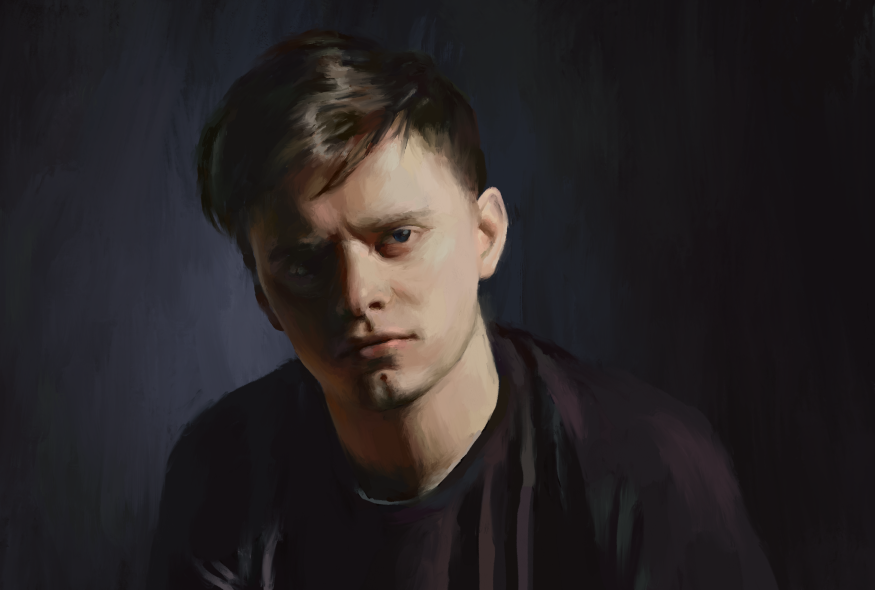
Yurii Kerpatenko: A conductor with principles

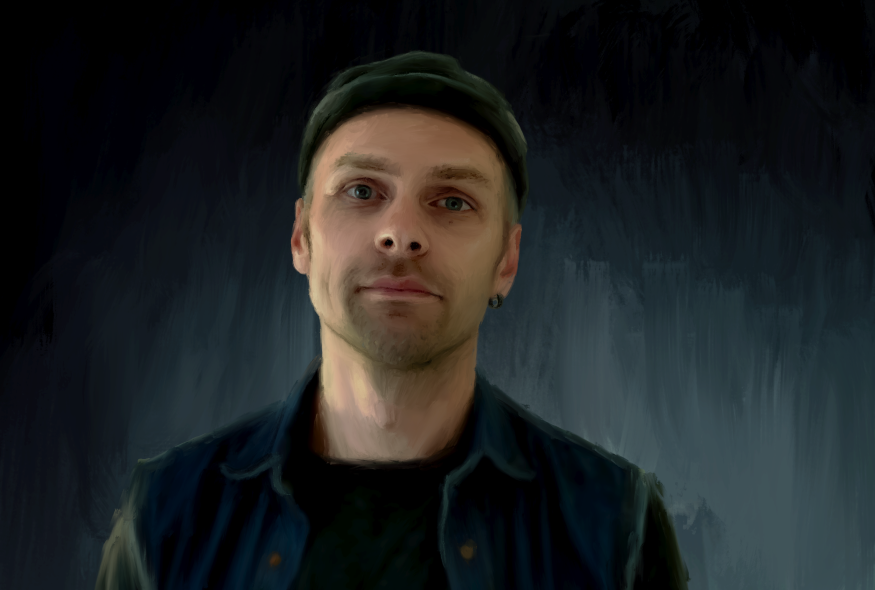
"I am a Russian-speaking Ukrainian living in Kherson. There is no need to save me by threatening me. [...] There is no need to bring the ‘Russian world’ to Kherson and turn us into Novorossiya," wrote musician Yuriy Kerpatenko on his Facebook page in the spring of 2021. Exactly a year later, when Kherson was already under Russian occupation, he would repost this message once again, despite the danger it posed to his life.
A few months later, on September 27, 2022, Russian occupiers would shoot Yuriy Kerpatenko through the door of his own apartment for refusing to conduct a staged concert organized by them.
The musician’s wife, who was with him at that moment, sustained severe injuries. Hearing the approaching occupiers, the couple embraced and exchanged words of love for the last time. "Music was his life," recalled Maryna Atsekhovska, who spent the last 12 years of her life with Kerpatenko. It can be assumed that his enthusiasm for music and commitment to ethical principles stemmed from a common source. As a conductor, he evidently understood that music, like society, is defined by its own set of governing principles.
**
A year before the full-scale invasion, Yuriy Kerpatenko engaged in a Facebook discussion with his colleague from the Kherson Philharmonic, Nadiia Sytar, who claimed that the triumph of the "Russian world" was impossible. "Putin will physically destroy you under the pretext that you are prohibited from speaking Russian," Kerpatenko expressed his forebodings. Living just 100 kilometers from Crimea, the musician well understood the possibility of the "little green men" creeping toward Kherson.
A year and a half after their online exchange, the colleagues had an in-person conversation. In the Philharmonic, then occupied by the aggressors, Sytar tried to convince Kerpatenko to agree to cooperate with the enemy–they needed a conductor for a concert on Music Day, and the Russians demanded it. Kerpatenko’s position was unyielding. "I will not collaborate with the Russians!" declared the musician. Afterward, he shared deep frustration with those close to him, stating that his colleagues had indeed agreed to play to the tune of those who bring death.
Local collaborators’ complicity in crimes horrified Kerpatenko, perhaps even more so than the Russians. In the first months of the occupation, the conductor wrote on his Facebook page about the danger of the "Saldo effect," a reference to the former mayor of Kherson and a staunch collaborator. "Saldo is so permanent, local, supposedly one of us, but not really," Kerpatenko marveled. It was as if he sensed that proximity to evil was more dangerous, and the responsibility for it was greater because it grew right nearby.
"Yuriy was an inflexible person, which could be challenging in the post-Soviet space, as there are very few places, especially in music, where the ability to compromise is not demanded," noted Andrii Shypunov, who studied with Kerpatenko at the National Music Academy of Ukraine, which is still named after Russian composer Pyotr Tchaikovsky.
During his student years, most musicians, in order to make a living, worked in restaurants and on cruise ships. Under no circumstances did Kerpatenko agree to such work, considering it beneath the dignity of an academic musician and conductor. "There is a lack of dedication to principles like Yurii’s in our society," noted Andrii Shypunov.
Perhaps that’s why those who stick to their principles often end up paying the ultimate price—their lives.
**
"Externally restrained but internally passionate and emotional," that’s how Svitlana Duminska, the head of the Culture Department of the Kherson City Council, remembered Yurii Kerpatenko. He spoke sparingly but effectively, with a booming voice that filled the space around him. Kerpatenko was clear-cut and straightforward in his opinions, and also had grand plans.
In the early 2000s, most musicians sought to stay in Kyiv after completing their studies at the conservatory. However, the easy or lucrative paths did not satisfy the high standards that young Kerpatenko set for himself and his profession. The conductor returned to his hometown and initially took on part-time work with the Hileia chamber orchestra. Later, he secured a permanent position in the Kherson Regional Music and Drama Theater orchestra named after Mykola Kulish.
"Upon arriving at the theater, Yurii immediately set about rebuilding the ensemble. He was purposeful and demanding, organizing auditions for musicians, which was unprecedented, and making everyone work hard," recalls Terentii Shevchenko, who played in the theater orchestra. Young Kerpatenko understood that one couldn’t expect great achievements in the provinces. Therefore, he began preparing solo programs, creating a kind of philharmonic from the small theater orchestra. Even in a small institution, he had grand ambitions.
In addition to his work in the theater, the conductor was heavily involved in arranging and orchestrating on commission. In 2015, Kerpatenko co-founded his own music studio, Sirius Prime, along with Serhii Chornous, Oleksandr Vasylenko, and Oleh Volontirtsev. The music studio gathered the best local musicians and vocalists. "We had an orchestra of 70 people, about 30 choir members, computer graphics, orchestral, digital sound, video — and we did it all in Kherson," recalled Serhii Chornous. Kerpatenko considered working at Sirius Prime as an investment in his own significant venture.
Finally, in August 2021, Kerpatenko took on the position of the chief conductor of the Hileia chamber orchestra at the Kherson Regional Philharmonic. The position was long-awaited and, at the same time, demanding. The Philharmonic building burned down in the mid-90s, so the orchestra rehearsed in a small basement classroom and performed on the stages of various cultural centers or museums. Despite this, all the musicians respected Kerpatenko. "Yurii knew how to approach both a beginner performer and a seasoned artist. And when something wasn’t right, he took a long time to find the right words and expressions to describe the problem, so as not to offend anyone," recalled Serhii Chornous.
**
Yurii Kerpatenko firmly avoided using a smartphone and had a phenomenal memory; he could intricately describe all the trolleybus routes in Kherson over the decades or recall the neighbors and room numbers in the Kyiv conservatory dormitory by name. He could memorize music of any complexity and instantly reproduce it on the piano after listening to it just once. He played the accordion skillfully and passionately.
Even while studying in Kyiv, Kerpatenko had the courage to embody his own interpretation of a musical piece, which didn’t always align with the interpretation of his authoritative teacher, conductor Vadym Hniedash. "Not many dared to do that in our class," recalled Andrii Bereza, who studied alongside Yurii.
Kerpatenko’s views on art, music, and the world echoed the latest philosophical trends: "You know, it’s human nature to want to be able to do many things. But we cannot transform everything directly, and in this sense, you need to calmly accept that when you can assess the quality of what others have done or created, you are, in a sense, contemporaries, because at that moment your brain reproduces the intellectual object you perceive, if, of course, you are not lazy," wrote the conductor in the summer of 2021 on social media.
As French philosophers declared in the mid-20th century, those who perceived art worked no less than those who created it, and as physicists told us even earlier, the experimenter's presence influenced the result of the experiment.
"Start with RESEARCH, then move to active PRACTICE, and finally, engage in TEACHING... It’s ideal to embody all three roles within one person," the conductor continued. Don’t such trains of thought resemble the idea of the interdisciplinary nature of science and art that have been so popular over the past decades?
"The biggest problem in the education system is that those of us who come into this world are taught more to follow than to explore it. Knowledge instead of understanding and interest in the process of cognition," we read on Kerpatenko's social media. In his opinion, every person, not just those who called themselves scientists, had to be an explorer. Because such an investigative view of the world laid the foundations for a complex society.
**
Yurii Kerpatenko was Russian-speaking, but throughout his life, he remained strongly pro-Ukrainian in the often ambivalent environment of Kherson. Nurtured in an environment heavily influenced by Russification at the Kyiv Conservatory, Kerpatenko frequently appealed to Ukrainian composers Levko Revutsky and Borys Lyatoshynsky as foundational figures for Ukraine. He wrote quality arrangements of Ukrainian folk songs, spoke about talented Ukrainian conductors, and saw the world through the lens of music.
Colleagues noted that Kerpatenko viewed the world through music. He shared the "Scythian Suite" by Soviet Russian composer Sergei Prokofiev on his Facebook page three times, the last one being during the occupation. Before the war, the conductor admired the skillful representation of the sun’s sound in the composition’s final part, describing this music as wild and frenetic. Only later did he realize that perhaps this very feverishness nurtured over centuries by Russian culture was what caused an attack on Kherson.
"I understand that I understand nothing," he wrote about the composition during the occupation. "The performance is fine, but the reality behind it is a bit off," the conductor continued his thoughts in the comments, evidently sensing the real defeat of the so-called high culture on which he, among other things, had been nurtured. Perhaps he felt that this defeat was not just the defeat of Russian or Soviet culture but of culture itself, the culture that was his life, and therefore, a personal defeat.
Colleagues and friends remembered Kerpatenko as principled and demanding of himself. What should we, who mostly discovered him after his death, learn from the conductor who stood by his principles? I think Kerpatenko gave all Ukrainians a lesson in responsibility—for Kherson, their beliefs, their small orchestra, who they are and where they live, and their culture. He dedicated himself to his work without pursuing fame or personal gain, investing all his energy and, in the end, even his life into it.
"Not in vain did the samurai say: live as if you are already dead," Yurii Kerpatenko wrote. The principled conductor is gone. Now, someone has to live like him in his place.
Yurii Kerpatenko was born on September 9, 1976, in Kherson. In 1991, he graduated from a music school, and in 1995, from a music college in Kherson, specializing in the accordion at both institutions. In college, he also studied composition as an elective. He composed a series of works for the accordion, piano, folk, and chamber orchestras, which became part of the repertoire of the Folk Orchestra of Kherson Music School, various folk instrument ensembles, and the Hileia chamber orchestra of the Kherson Regional Philharmonic. In 2000, he graduated from the National Music Academy named after Pyotr Tchaikovsky in Kyiv with a degree in the accordion, and in 2004, from the Department of Opera and Symphonic Conducting, studying under People’s Artist of Ukraine Vadym Hniedash. Immediately after that, he worked as the chief conductor of the Hileia chamber orchestra at the Kherson Philharmonic. From 2004 to 2014, he served as the chief conductor of the Kherson Music and Drama Theater named after Mykola Kulish. Under Kerpatenko’s leadership, the theater orchestra reached the peak of its popularity. After leaving the theater, he engaged in arranging music, and fulfilling orders for ensembles and orchestras. In 2015, he co-founded his own music studio, Sirius Prime, along with Serhii Chornous, Oleksandr Vasylenko, and Oleh Volontirtsev. From August 2021 onward, he held the position of chief conductor of the Hileia chamber orchestra of the Kherson Regional Philharmonic. On September 27, 2022, Russian occupiers killed Yurii Kerpatenko for refusing to collaborate with them. Today, a street in Kherson where he spent his childhood bears his name.
Read also:
We need your help to create projects and materials aimed to defend freedom of speech, popularize Ukrainian culture and values of independent journalism.
Your donation means support for discussions, awards, festivals, authors’ trips to regions and PEN book publications.