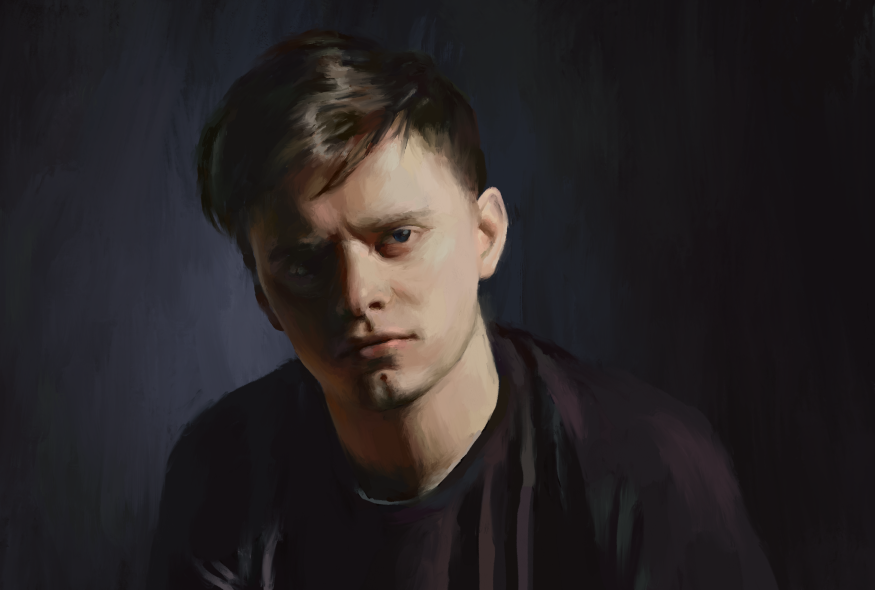
Volodymyr Chornyi: Atlas Holding Up the Sky
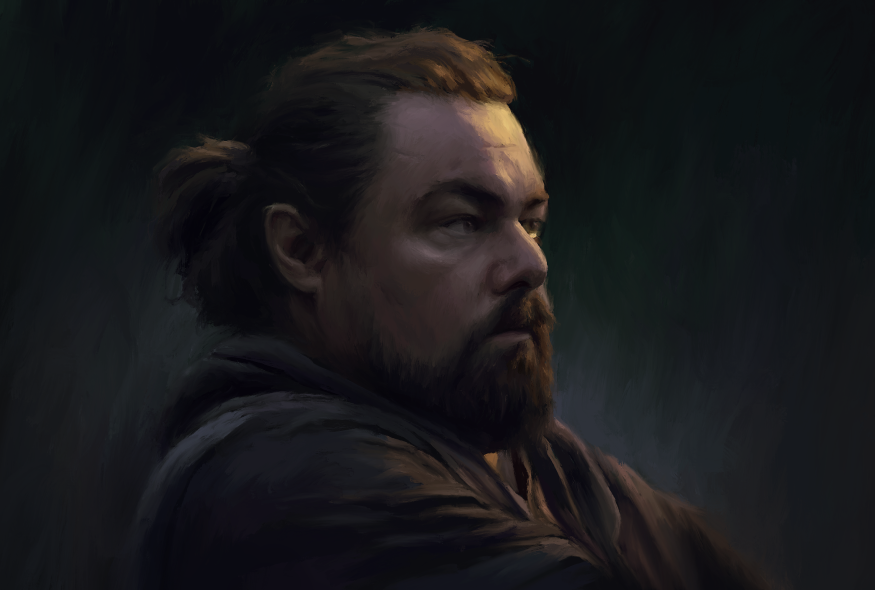
"His perspective on things was truly unconventional. In addition to his brilliant mind, which was richly laden with knowledge, he was driven by some mighty force, an innate urge for interpretation," read one of the numerous obituaries for the artist Volodymyr Chornyi on social media. In the portrait of the fallen, a robust-looking man with thick wavy hair down to his shoulders gazes at us, an image reminiscent of an ancient Greek god or hero from Homer’s Illiad.
The artist Chornyi, who went by the call sign "Kara" (which translates from Turkic languages as "black" and also alludes to retribution against one’s enemies. ), perished in a battle against Russian forces on May 9, 2023. Chornyi died on a day he detested–Victory Day, a Soviet holiday, the falseness of which Ukrainians are only beginning to comprehend.
"All those passing through the crucible of war, like wood and coal entering the whirlpool of events, emerge transformed as ashes and smoke," wrote Chornyi in one of his narratives from the front.
His wife Olena Biletska wears a damaged key to their apartment around her neck–it was returned to her along with Chornyi’s other belongings after his death. "This is all that’s left of my husband," explained Biletska. Chornyi, scattered as ashes and smoke in the fields of Luhansk, nevertheless left behind much more than just that key. His legacy endures in his art, cinema, and in the hearts of those close to him.
**
At the National Academy of Fine Arts and Architecture, Volodymyr Chornyi became a true legend–he applied seven times before finally being admitted. Chornyi was bright and determined to get into university on his own merits rather than relying on personal connections (which was common practice back then). Eventually, he secured a government-funded slot in 2005 and became a student in Professor Andriy Chebykin’s graphics workshop.
"After every unsuccessful attempt, Volodymyr made friends and thus formed a network of acquaintances. He entered the first year already mature. It seems our lengthy discussions on philosophy and art, our visits to exhibitions inspired our creative development even more than our university education," recalled Iryna Kostyshyna, who studied with Chornyi.
The artist combined a meticulous analytical approach with a passion for experiments. In his graphic works, he was intrigued by technical nuances, experimenting with printing, style, composition, the unexpected mixing of colors, and etching unconventional-sized and shaped drawings. "Oh, how I like this color; you can paint your beloved’s breasts without needing to swipe the brush for too long," the artist described the pink shade of thioindigo.
Chornyi never showcased his work in a solo exhibition during his lifetime. After his death, his wife and friends organized a posthumous exhibition in his honor. "We wanted to showcase the process of Volodymyr’s journey as an artist, things that inspired and troubled him, his stream of thought — starting from small sketches to finished prints," said artist Taras Kovach.
"The Dance of Life," a series of etchings created as Chornyi’s university capstone project in 2011, impresses with its complexity. "To print four etchings with a size of 1400 by 600 mm is a real technical challenge," explained Volodymyr Lyubyi, a teacher and colleague of the artist. The work, depicting the relationship between a man and a woman, as well as the essence of human life, serves as a key to Chornyi’s posthumous exhibition.
"This series is figurative but unlike anything else; each line in it shows Chornyi’s unique character," said Iryna Kostyshyna.
The four etchings from the series were hung arbitrarily since the author left no instructions regarding the order. This dilemma prompted an experiment: visitors were invited to think about the possible sequence of the works, and they found a logic in it. The initial excitement of the first encounter transforms into an awareness of the weight of excessive attachment, fostering the need to liberate oneself from constraints. This journey ultimately culminates in a sense of indifference between those who were briefly close.
Friends recall Chornyi spontaneously dancing while singing along to Georgian, Azerbaijani, and Syrian folk songs. His "Dance of Life" is perhaps intentionally devoid of structure so that the viewer’s imagination could gradually dance, sliding their gaze between the four etchings.
**
As a film set decorator, Volodymyr Chornyi enjoyed new challenges from working with textures. For film shoots, the location is often built from scratch and undergoes multiple transformations. Unnoticeable to the viewer, this work is both physically and mentally demanding.
For the film Brama by Volodymyr Tykhyi, Chornyi had to clear algae from a swamp pit and then transform it into a lake. For the movie Nashi Kotyky by the same director, he constructed the bunker embrasure decoration entirely. He installed it on a natural slope, then transported it to the studio and enhanced it with additional decorative elements. During the filming of Iron Butterflies by Roman Liubyi, which tells the story of when Russian terrorists downed flight MH17 over Donetsk Oblast, the whole team waited for forecasted snow as per the script. When snow suddenly started to fall, Chornyi swiftly assembled the airplane turbine in the cold, went inside it, and manually turned it himself.
For the film Pamfir by Dmytro Sukholytky-Sobchuk, the set decorator repainted the prayer house several times. The brown decoration was initially primed, then transformed into a blue hue, followed by the appearance of having been damaged by fire, and finally, a texture resembling burnt walls was added. Some photos from that time still exist, showing Chornyi with a spray gun, his face covered in either greenish or black paint. "We used to joke: now Chornyi is black, but before, he was green," recalled the film’s director, Dmytro Sukholytky-Sobchuk.
"I want to call him a Renaissance man for the multidimensionality of his thinking and love for details," said Ivan Mykhailov, the production designer of Pamfir. Chornyi, like Atlas from ancient Greek myths, seemed capable of holding up the sky on his own. His tasks, whether a clever film set decoration or making borshch for friends in a trench, seemed to unfold effortlessly and almost on their own. His brothers-in-arms recalled that even amid war, he created a sense of home and tranquility.
**
It took some time for Chornyi to be accepted into the military, much like getting into the academy. His documents regarding the experience of his conscript service in the mid-90s got lost somewhere between military offices. With the onset of the full-scale war, the artist finally got the opportunity to fight.
"Volodymyr didn’t like the military and everything related to uniform," recalled his sister Olena Sіlkіna. "He loved freedom and art." Despite this, volunteer Chornyi rose to the rank of chief sergeant. He realized that being a citizen entailed not only rights but also responsibilities. Those around him felt it, too. "Responsibility begins with oneself," Chornyi reiterated to his wife Olena Biletska. "When we don’t like something, we should reflect on how we allowed it to happen."
Before heading to the front, Chornyi prepared himself like a samurai. His extensive experience in mountain hikes to remote areas, his ability to navigate any terrain, and survive in challenging conditions proved invaluable. But even with these skills, serving in the military was difficult for Chornyi, as it is for most of those whom we commonly perceive as heroes.
"The wounded suffer physically, the people carrying them pay no attention to fatigue; they suffer out of empathy, and you, in your thoughts, without noticing it, console either the wounded soldier etched into your memory or yourself: ‘Not today. Not now. Everything will be fine. Hang in there,’" Chornyi described his search for inner strength during the war.
But even on the front line, Chornyi maintained his artist’s perspective. Perhaps the ability to notice the poignant amid the danger of war gave him strength. "Once, Volodymyr sent me a video of a beautiful white horse wandering in the middle of their positions. Everything around was exploding, and he found a moment to capture the horse for me," recalled Olena Biletska.
Holding up the sky is not easy, even for someone as strong in spirit and body as Chornyi. But to whom can such a burden be transferred? "We must continue, no matter how painful it may be. [...] We are the ones buying time for the professional army of Ukraine. We are proud of their achievements but do not forget us. We are the ones eating dirt so that everything around us continues to exist…" wrote the artist in October 2022 about the Kharkiv counteroffensive, which seemed like a miracle for Ukrainians and the world. But miracles don’t happen, as Chornyi reminded others. Every step has its cost.
**
Volodymyr Chornyi loved nature as passionately as art. He gazed at it attentively and carefully–to see but not disturb.
"These branches were eaten by cordyceps Volodymyr sent from the front," said Olena Biletska. On the enemy positions, a sniper systematically cut down the dry acacia bushes. Chornyi picked up a few branches and turned them into an art object. The lines eaten by insects on the sniper's pruned branches were referred to as the inexplicable inscriptions of cordyceps.
Along with his friend Oleh Baklazhov, Chornyi explored the wild areas of Kyiv, Ukraine, and the world. Once, in winter, the friends decided to greet the dawn in a tent near the Kyiv Sea. That night, the temperature dropped to -28 degrees Celsius. "In the forest, all night long, trees were falling, and the heartwood cracked from the cold. With each falling tree, our hearts shuddered a bit. It seemed like the tree trunks were flying straight at us," recounted the artist’s friend.
In a few years, already during the war, Chornyi listened to entirely different explosions at night. Sitting in the trenches, the artist made plans for victory: to continue illustrations of Lewis Carroll’s work, create a series depicting the Icelandic cycle of myths, conduct landscape and botanical-zoological studies, and so on. Chornyi planned to return to compositions using a tsuba, a small metal plate on a sword that prevents hands from sliding from the handle onto the blade and, to some extent, protects against strikes. The shape of the tsuba was the subject of Chornyi’s project titled "The Dream of Man," depicting the collision of two civilizations. In the spring of 2023, Chornyi seemed to have encountered such a collision firsthand. And this encounter abruptly cut his life short.
"This landscape, with its drooping, blackened sunflowers, strongly reminds me of how people are impacted by war. We are all born as flowers of the sun, but war makes everyone roughened, drooping sunflowers. And yet each of us holds within ourselves a seed that must sprout with new ideas, impulses, plans, and actions," the artist described the trials of war.
An epic figure, Samson, a pillar of strength—he shouldered a lot of responsibilities and always followed through. But he was only a human being. Like each of us. Now, someone else must hold up the sky, to which the artist and soldier Volodymyr Chornyi offered his shoulders.
Read also:
We need your help to create projects and materials aimed to defend freedom of speech, popularize Ukrainian culture and values of independent journalism.
Your donation means support for discussions, awards, festivals, authors’ trips to regions and PEN book publications.