Viktor Onysko: Editing Reality
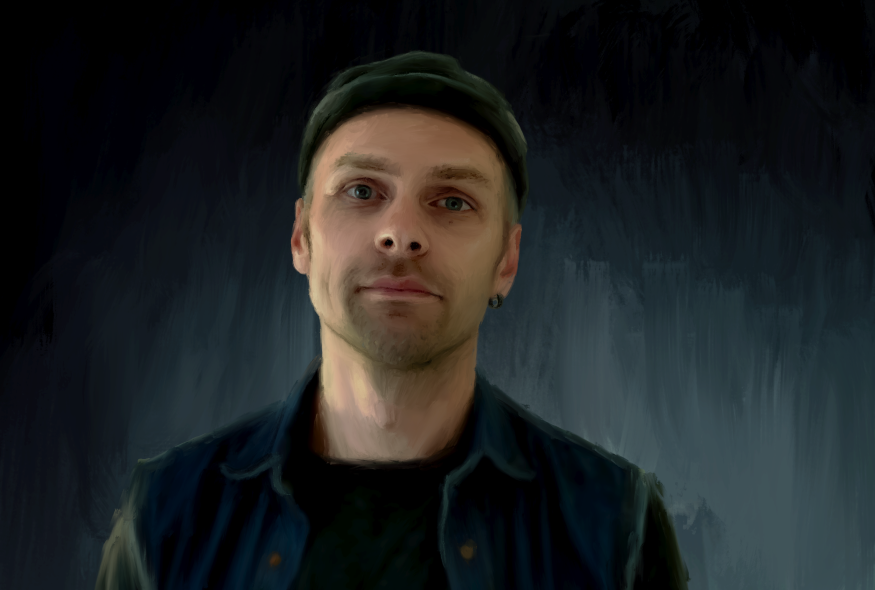
"I would really like to visit his grave with you," I write to Olha Birzul, the wife of the late film editor Viktor Onysko, proposing a conversation about memories.
"Vitya embodied life, music, cinema, adventure, and a sense of humor even in the toughest times. His grave at Baikove is certainly not the place where I would prefer to speak about him," Olha replies. She shares a link to a video that friends made after Onysko's death in honor of his birthday.
In the recordings, Viktor dances with his daughter Zakhariia amidst the steppes of Kherson, plays musical instruments while wearing quirky glasses, and shoots arrows from a toy bow at her in their apartment—all accompanied by drums as they screech "The Naked King," a song by the band Boombox. Even in a helmet and uniform, surrounded by the booming artillery, Onysko walks through a partially destroyed town in the east—and sings.
"I am a nuclear reactor powered by enriched breakbeat, dance with me," he once wrote on his Facebook.
I watch the video. My body wants to dance. My soul wants to cry. I draw energy from this reactor.
***
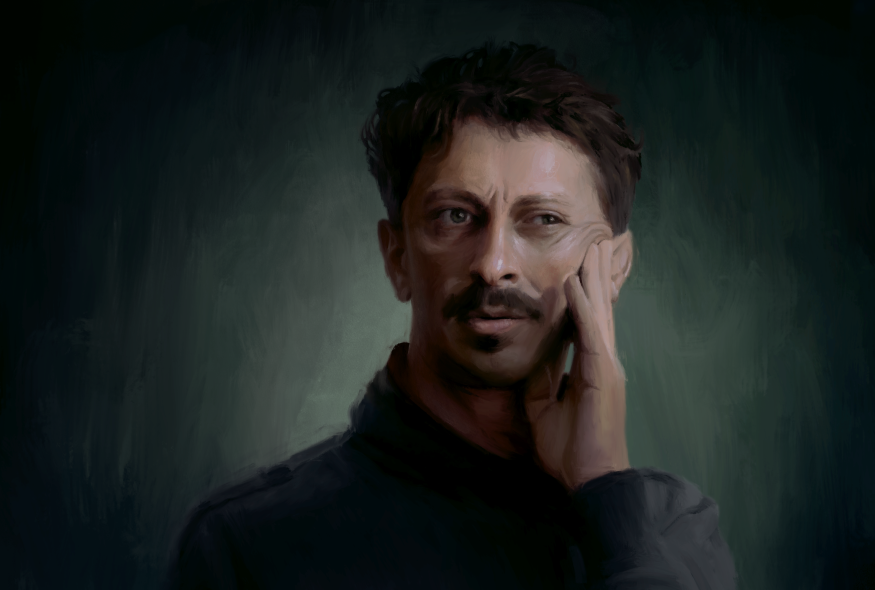
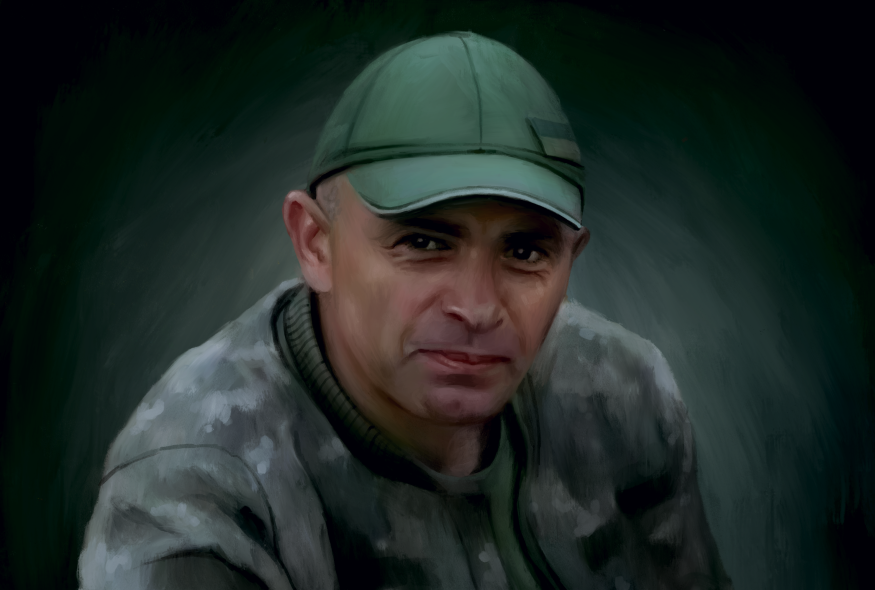
Viktor Onysko was a Ukrainian film editor, soldier, and junior lieutenant in the Armed Forces of Ukraine. These two identities collided with the onset of a large-scale war and his decision to take up arms to defend his homeland.
"Those who fought since 2014 allowed us eight years to raise our child. Now it’s my turn to let the younger guys be with their loved ones," Onysko explained his decision to his wife.
He left the editing of Mariia Stoyanova's documentary Fragments of Ice and Roman Bondarchuk's feature film The Editorial unfinished. Both will soon be released in his memory.
"Thanks to his love for music, Vitya had a fantastic sense of rhythm, which is crucial in editing," says Roman Bondarchuk, a director and friend of Onysko.
In film editing, changing even a single element not only alters what follows but also reshapes the audience's perception of everything that came before. Even in a well-written, well-acted dialogue, there may be an unnecessary beat—something the film editor must catch.
"Vitya had a somewhat mystical intuition for this that was highly developed," notes Bondarchuk.
In the fall of 2021, Onysko spent time shooting The Editorial in Kherson region, and by the autumn of 2022, he was liberating those same steppes from Russian occupation. "We’re fighting for your land and now my land," he wrote to Bondarchuk, who was born in Kherson.
On the film set, Onysko was fully engaged, often stepping forward to propose unconventional acting choices. To lift the spirits of the crew, he played his favorite music during breaks. On weekends, he would escape to explore the local landscapes.
A film editor is essentially the first person to sift through a mountain of footage and help the author shape the film's structure, invent its tone and style, and build visual sentences, according to director Maryna Stepanska. It’s no surprise that the film editor is often regarded as a co-author of the film.
"Why are you shooting so boringly?" Onysko would jokingly ask when the cinematographer and director showed him their drafts: "Think outside the box!"
By the time he was serving in the military, Bondarchuk had been trying in vain to convince Onysko to take leave and finish editing the film. Vitya never believed that, as a member of the film industry, he should have privileges over other professions.
"When the Revolution of Dignity began, I grabbed a camera and started filming. Vitya went out to actively protest on the Maidan despite the fact that he and Olya had just had a baby. After Yanukovych fled, he bought a rifle 'so that I would never again be unarmed in front of a squad of armed Berkut officers.' He sold it only a few years later to buy a motorcycle for seven-year-old Zakhariia," recalls Roman Bondarchuk.
Onysko joined the military as a "suit," someone with no experience but holding a military rank. He quickly rose to command a platoon, and later a company. It soon became evident that his work in both war and film shared many similarities.
His profession earned Viktor the call sign "Tarantino." In his last posts and messages, he referred to himself as such. "If you have a connection to film, then you are 'Tarantino,'" writes Oleksandr Mykhed in the chapter of the book The Language of War dedicated to Viktor Onysko.
"I thought that an effective commander organizes a group of motivated people to achieve a result together. But it turned out that an effective commander is one who can make even the last fool useful," Viktor told Maryna Stepanska from the front lines. He mistakenly thought that he would get a break from working with people in the army.
"To Viktor Onysko, who taught me that there is no better film than real life," reads the dedication in Your Book About Cinema by Olha Birzul, published in March 2024. This book, originally conceived with her husband during the happiest period of their lives before the full-scale war, was completed in the midst of their greatest tragedy—his death.
"Vitya left behind many connections, and one of them is through editing. My book is structured around the principles of film editing. I’ve named each chapter like different types of shots: a long shot on the history of cinema, a medium shot on the stages of production, a close-up on various professions, and a detail shot on the nuances of the film industry," shares the author.
In a separate chapter, Ukrainian filmmakers tell teenagers about their professions and recommend coming-of-age films. Viktor Onysko wrote from the front: "I manage to see thousands of versions of the same film, so it's perfectly normal for me to cry in the editing room in front of the monitor or to laugh, be scared, be amazed, feel nervous, or even experience everything at once. The magic of editing lies in the manipulation of attention and emotions."
In a sense, his life was already about editing—the editing of emotions for others. He was passionate about motocross, gifted his then-seven-year-old daughter a motorcycle, and provided her with unforgettable riding experiences, loved music, attended concerts, and enjoyed traveling. Just before the invasion, for his birthday, he received a DJ console to entertain his friends feeling stuck in their forties.
"It’s very hard for me to talk about Vitya as a separate person. Over 17 years, our lives became intertwined. We had a very rich life. Alongside work, protests, and parenthood, we managed to fit in a lot of interesting things like concerts, film festivals, travels, motorcycles, bicycles, and winter skiing with snowboarding. Vitya could pull not only quality films from reality but also vibrant adventures," Olha Birzul wrote to me following our lengthy conversation about her husband.
***
Viktor Onysko died around 7:00 a.m. on December 30, 2022, near Soledar. That day, at 2:00 p.m., he was supposed to lead his brothers-in-arms out of their positions. They did manage to leave Soledar, but without Tarantino.
In the evening, the news of his death reached his wife and daughter. The next day, Olha Birzul and Zakhariia boarded a train and faced the most terrifying New Year of their lives.
There was no conventional funeral. Together with friends from the cultural community—filmmakers, writers, artists, and musicians—the family held a farewell party to send Onysko off, playing his favorite tracks. "It was an absolutely crazy infernal event. We cried, laughed, and danced. And it felt like Vitya was with us, dancing on video from the screen," Olha recalls.
His ashes were scattered on a Carpathian mountain near the place from which Onysko's father's family originates. Viktor adored the mountains and dreamed of settling down there one day.
"My task is to remember, preserve, and take revenge," says film curator Olha Birzul. For the 20th Docudays UA festival in 2023, she organized a special program called Cross Fade dedicated to the memory of Viktor Onysko. With this gesture, she aims to create a "unique architecture of memories" about her husband.
"I dream of passing on my love for my husband to my daughter," Olha says. She seeks to rethink traditional forms of commemoration and heroization, which "seem to erase the personal qualities of our defenders."
Viktor Onysko, also known as Tarantino, was a cultural figure who did not seek to become a hero. He said that a reasonable adult, regardless of their profession, cannot forgive the evil that the Russians brought to our lands.
"That’s why I always tell my daughter that her dad is music, cinema, and books, and that he is always with us, helping us. We have lost him only physically, and over time, we will learn to feel his presence and support, and we will preserve his feat for future generations," shares Olha.
***
"Even if this is the apocalypse, I don't want to meet it with a sour face," said Viktor Onysko as he joins the military in early 2022. "When editing allows for even a bit of creative freedom, it always retains something very personal," he wrote about his work.
"Every new morning proves that the impossible is possible. And let me remind you—we will definitely win. [...] Greetings from the heart of darkness," he said after the liberation of Kherson.
Once, after the death of a friend before the full-scale war, Viktor Onysko wrote: "Learn to keep people in your heart, even when they are no longer by your side." It seems that his loved ones have taken this to heart, using it as both a weapon and a source of comfort.
Read also:
We need your help to create projects and materials aimed to defend freedom of speech, popularize Ukrainian culture and values of independent journalism.
Your donation means support for discussions, awards, festivals, authors’ trips to regions and PEN book publications.