Iryna Tsvila: Tending to Her Garden
In January 2017, Avdiivka was both freezing cold and burning hot at the same time. Cold, because a biting and relentless frost had set in, chilling to the bone. Hot, because after Ukrainian soldiers successfully reclaimed another small piece of land near the local industrial zone, the Russians flew into a rage. Unable to retake the lost position, they lashed out in indiscriminate fury, shelling the streets and residential buildings of Avdiivka.
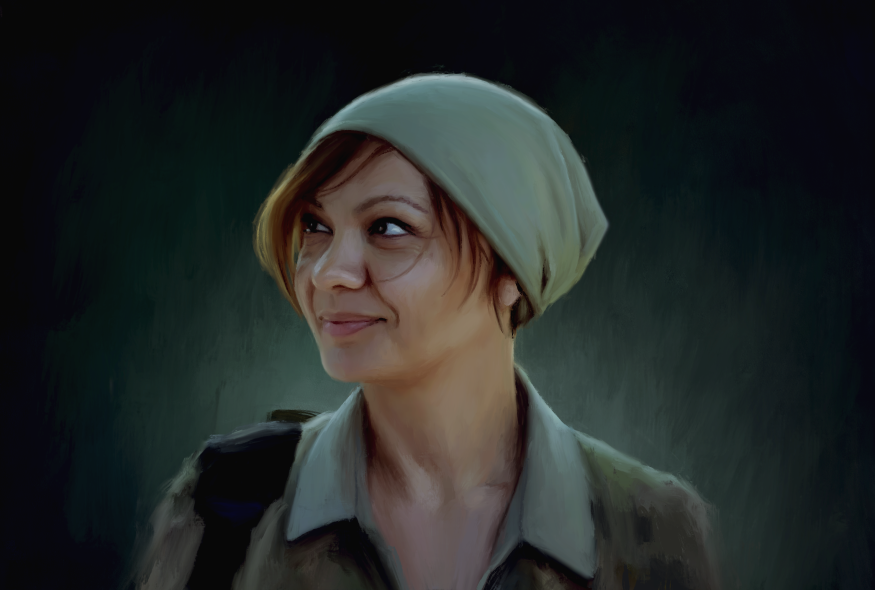
Due to the significant escalation in hostilities, journalists from all over the world were flocking to the city, including our film crew. Since there was no hotel in the city, the Kyiv Special Police Regiment, stationed in Avdiivka for another rotation, kindly agreed to host us for a few nights. My camerawoman and I were placed with two women serving in the unit—"Lastivka" (Swallow) and "Lynza" (Lens). The room had two makeshift beds—mattresses on the floor covered with blankets. One of the soldiers, Lynza—dark-haired, with a short cut and piercing brown eyes—helped set up a third bed for us. She introduced herself as Iryna.
That evening, we didn’t talk much, but later that night, when the city grew loud again, I woke up from another explosion and saw Iryna adding wood to the stove. She moved carefully, as if measuring every motion to avoid waking anyone. I caught myself thinking how this incredibly beautiful, striking, and graceful woman, even in military thermals, resembled an actress from a French retro film. I could easily picture her in a long silk gown, walking down a red carpet.
In the morning, when we woke up, Iryna was already gone from the room. The unit’s beloved cat was going into labor then, and Iryna was running around the building trying to create the most comfortable conditions for the fluffy mother. In the end, she set up a makeshift delivery room for the cat using a box from ammunition, lined with a piece of faux fur (and how she found that in those conditions is a mystery). She was overjoyed when, an hour later, a squeak came from the box. In wartime, witnessing the emergence of new life is especially precious, as if it triumphs over the death surrounding us.
This was Iryna Tsvila—she believed it was important to care for everyone, from the abandoned animals on the front lines to her brothers- and sisters-in-arms, as well as the strangers who happened to be nearby and needed a place to stay for the night. Ultimately, she cared for the millions of Ukrainians she went to defend on the front lines.
"I want to be useful," Iryna always said.
**
During one of our visits, Iryna showed me photos from the Maidan on her laptop. That was where her war began. Throughout those months, Tsvila was in the very heart of the Revolution of Dignity with her camera, capturing historical events and those who were making them happen. Her photos, which showcase her remarkable talent as a photojournalist, have become invaluable, especially because many of those she captured through her lens are no longer with us.
On February 18, 2014, Iryna found herself in a crowd of protesters on Kryposnyi Lane. At one moment, one of the protesters fell at her feet. She didn’t see his face—it was completely covered in blood—but she forever remembered his red-and-black scarf. Later, she learned his name— Ihor Serdiuk from Kremenchuk. He became known as one of the Heavenly Hundred who were killed during the protests. That day became a turning point for Iryna.
Then the war began. At that time, women in the Armed Forces were a rare phenomenon: they were not only barred from combat positions but also from serving as photographers and translators, for example. So, Iryna joined the Sich volunteer battalion. A teacher by profession, she had never handled a weapon before, so she had to learn everything from scratch.
**
Before the war, Iryna Tsvila’s passion was flowers. She seemed to have read everything available about roses, collecting various samples and observing how they adapted to local conditions. Her collection was impressive. Over 500 varieties of roses from around the world grew in her garden, including those from Serbia, France, and the United Kingdom. Eventually, her hobby turned into work: Iryna began creating rose gardens for others. She calculated which varieties would be best suited for the local area, combined colors, and developed care recommendations for future flowerbeds.
Perhaps her love for roses was not coincidental. After all, Iryna herself resembled this flower—beautiful, delicate, and fragile, yet capable of defending herself, tough and uncompromising against injustice and anything that contradicted her principles. Language mattered to her, so she was disheartened by the lack of resources on roses in Ukrainian. This prompted Iryna to create her website dedicated to roses. She took the photographs, described the characteristics of different varieties, and began research work, seeking legends and tales featuring roses, as well as poems and works by Ukrainian authors about this flower. However, when the war began, Iryna chose to prioritize the defense of others’ lives over fulfilling her own dreams.
**
The "Republic of Cities," a key checkpoint and combat line in the Russo-Ukrainian war, marks the entrance to the village of Pisky and is one of the most renowned locations in Donbas during the Anti-Terrorist Operation (ATO). From there, it’s just a few kilometers to the already occupied Donetsk and the Donetsk airport, where a decisive battle was raging in the winter of 2014-2015. As a result, Pisky became one of the most challenging and dangerous points on the front line. On that day, Iryna Tsvila saw the realities of war for the first time with her own eyes.
She had been standing for hours at the checkpoint along with other soldiers, waiting for at least a brief pause in the shelling so they could quickly dash into the village where her unit was fighting. This was her second rotation in Donetsk region. Her unit was initially sent to the recently liberated Sloviansk in the summer of 2014.
"We arrived in the evening. We were accommodated in an aviation school. Everything was shattered or broken, with windows blown out and shell casings scattered across the rooms. It left quite a depressing impression. The first night in the ATO zone was very scary for me until I saw the first ray of sunlight through the windows covered with newspapers. It broke through a hole in the newspaper, and somehow my soul felt warmer and more optimistic. We patrolled the city. Our first rotation was made easy, so we could adapt a bit to the war. It was like an incubation period between peaceful life and battlefield," Ira recalled about her first days in the ATO.
During her second rotation, her unit was deployed to Pisky. However, her fellow soldiers didn’t take her with them—they left her at the base in Kurakhove. It took a lot of effort for Iryna to persuade them to let her go to the front line. And now, she stood just a few hundred meters from Pisky, afraid that she wouldn’t be able to handle it and would let them down. But she did everything she could not to show her fear so they wouldn’t send her back to the base. After five hours of continuous shelling, they were finally given permission to enter Pisky.
"The village was a total nightmare: devastated, littered with craters, everything destroyed and looted. There were tons of stray animals... It was heartbreaking seeing those skin-and-bone skeletons of once-beloved pets now abandoned, hungry, sick, and weak... Our guys often fed them. We even made rounds to feed the animals. We took many of them out of Pisky," Iryna recalled.
"Linza" liked to say that war strips everything away and reveals who you truly are. So, who was she? She was the kind of person who, despite fear and freezing temperatures, would head to her position to stand watch. After her shift, despite being exhausted, she’d cook borsch for her fellow soldiers so that when they returned from the cold trenches, they’d have something hot to eat. Though she was used to comfort and order, she quickly learned to live in basements and sleep as plaster from explosions fell onto her face. She even made peace with the front-line mice. And, of course, she took many photographs. For some of her comrades, the portraits she took became their last.
During the bitter cold on the front lines, Ira often thought about how yet another one of her flowers at home was probably dying, and in her mind, she would ask her garden for forgiveness. A few years later, she would put those feelings on paper—this is how the piece "Letter to the Garden" was born. It was published in the veterans’ anthology The Voice of War. That same book also featured her piece "For the First Time: Women at War with Russia," about the day at the "Republic of Cities" checkpoint when she first came face-to-face with the war and overcame her fear.
**
Returning from the front wasn’t easy for Iryna. She was hurt by the indifference of those who chose to ignore the war and by those who "didn’t understand" why people were fighting in Donbas. The loss of her comrades weighed heavily on her. It pained her that the war was still ongoing with no end in sight. While at war, Iryna saved the lives of people and animals, but after returning to civilian life, she began saving flowers from death.
"Flowers are short-lived, and they will wither. But with the help of epoxy resin, they can stay with you for a lifetime," Iryna said about her new passion, which she turned into a business. She began crafting jewelry from plants and epoxy resin—earrings, brooches, and decorated mirrors—which led to the creation of her brand, Verba. The name was carefully chosen: Iryna explained that the willow (verba) is a plant known for its ability to regenerate, even when broken. From that point on, she always carried a notebook or a book with her, ready to preserve any flower she might find for her herbarium.
She maintained an active lifestyle, sailing with her partner Dmytro Synyuka, along with studying, traveling, and participating in photo exhibitions. She won a photography course grant and was excited to see her skills improve, making her photos more professional. She shared her work in the Inspiration online photo gallery group.
In early February 2022, Ira created a collection of wedding accessories made from foamiran.
Then the situation began to escalate. Just a few days before the full-scale invasion, on February 21, Ira wrote on her Facebook page: "Well, no one expected it to be easy. We're preparing! We’re coming together!" She was ready to return to the front lines at any moment. On the first day of the invasion, she joined the defenders of Kyiv Oblast with her partner. They both died together the very next day—February 25, 2022.
Iryna ended her "Letter to the Garden" with a heartfelt promise:
"The time will come when I will return. I will cast aside my camouflage rags, don my gardening gloves, come to you, kneel, and sincerely say, 'Forgive me!' A renewed rose will bloom, and the stumps of broken trees will sprout cheerfully and with inspiration. You will teach me to love life again—the life of a passionate and devoted gardener, a lover of gardens and a dreamer of them. This will happen, I promise. I will return. Just wait for me, my Garden."
Now, all the roses in the world bloom for her.
Iryna’s legacy lives on through her daughter, Daria, who continues her work with Verba.
Read also:
We need your help to create projects and materials aimed to defend freedom of speech, popularize Ukrainian culture and values of independent journalism.
Your donation means support for discussions, awards, festivals, authors’ trips to regions and PEN book publications.