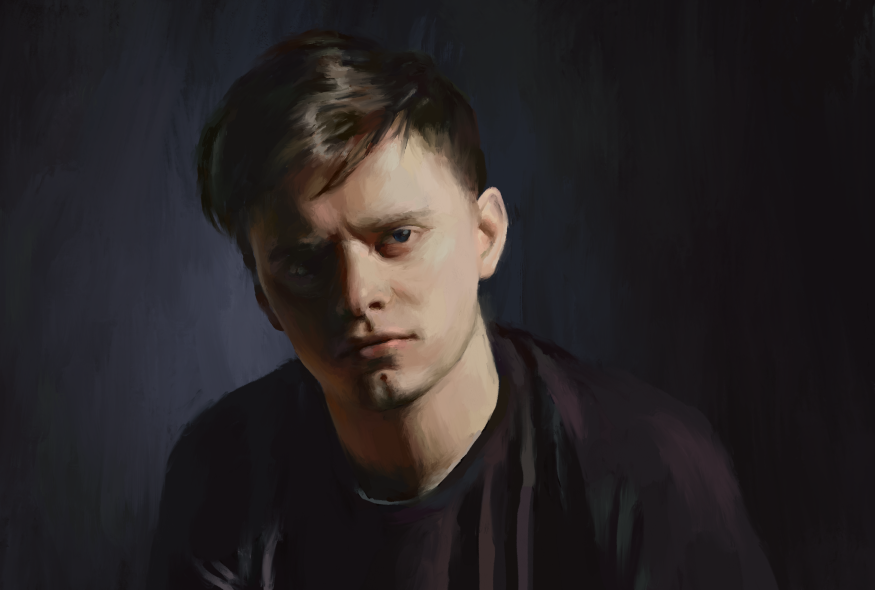
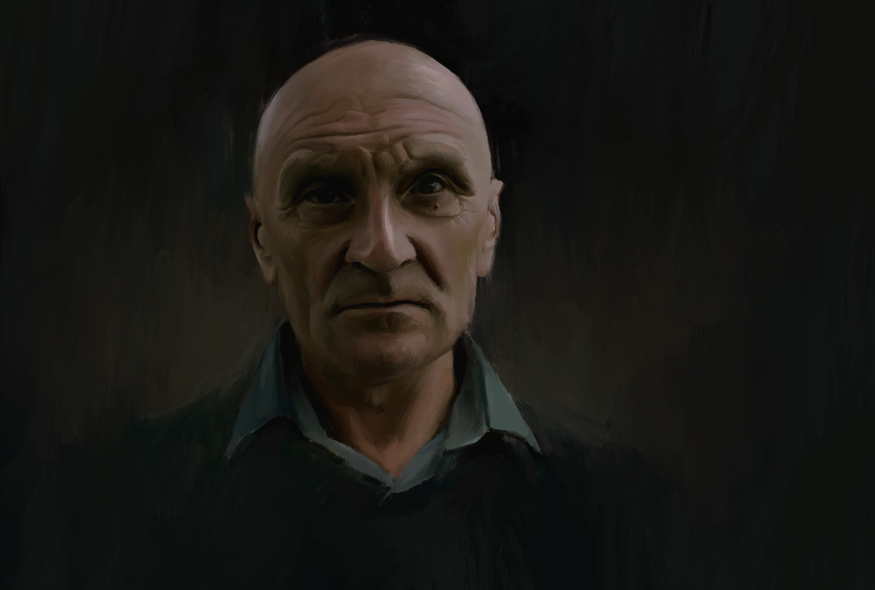
Oleksandr Kysliuk: A translator of austere disposition
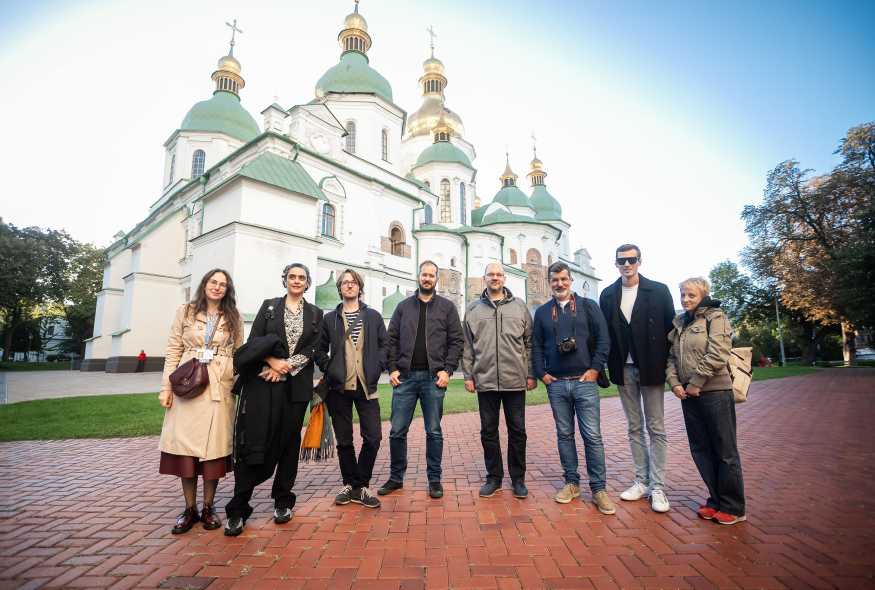
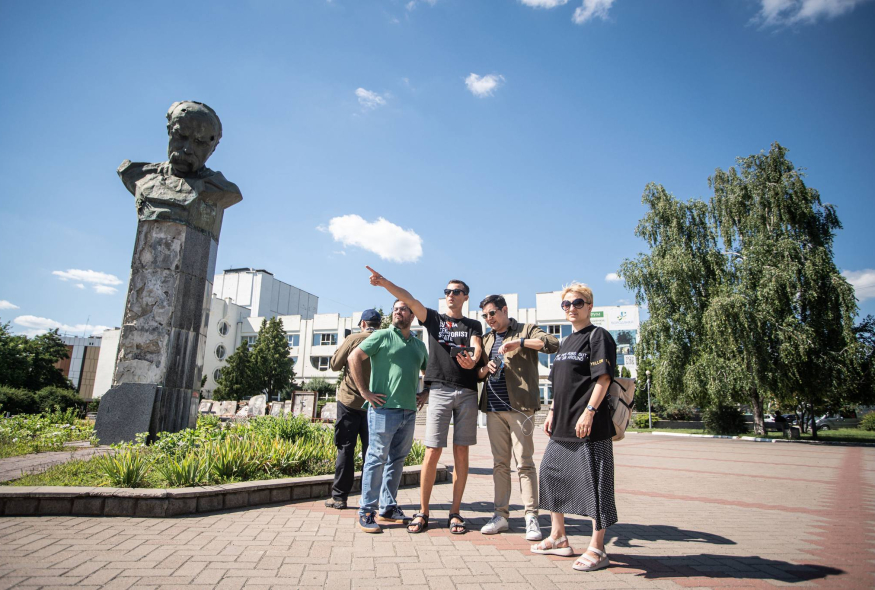
"Russian columns advanced along this road to Irpin," journalist Oleksandr Nakaznenko told us as we entered the city. He was my guide to the home of Oleksandr Kysliuk, a polyglot and translator, who had been shot dead presumably by one of those columns.
In the courtyard of the ruined house, we were greeted by Pavlo Kysliuk, the late Oleksandr’s twin brother. In early March 2022, Irpin had been engulfed by noise. He recalled how "Bucha and Hostomel were burning... Borodianka was being bombed, and the sounds of artillery were coming from everywhere, making us jump constantly." City residents were cut off from access to electricity. The Kysliuks and their tenants didn’t make an evacuation plan, though. They remained in the city, cooking food and preparing tea over an open fire.
On the day of our meeting, a cold March rain was drizzling. But that didn’t stop Pavlo from stepping out of his summer kitchen into the yard and stage the scene of the house being shelled on the day of his brother’s death: "On March 5, 2022, I was helping our soldiers dig a trench not far from home... When I saw the tanks, I dropped the shovel and ran behind the house... I heard how they were firing, firing, firing... A stream of fire... Until I saw someone with a rocket launcher standing on a tank right in front... I instantly ducked into the basement... I looked out and the whole house was in flames... It was just fine a moment ago, and then it was in flames... Gunfire started again... When it quieted down, I ran out... I saw a body on the doorstep... I thought it was someone from the military... And I ran into the basement of an apartment building…"
Pavlo was sure that there was nobody in the house. His brother had been planning to go to the store since early morning. Only in the evening did Pavlo find out that the charred body in his yard belonged to Oleksandr. However, returning to the house at night was dangerous.
According to the memories of the Kysliuks, who were the sole witnesses to the death of the translator, the shelling caught them right in the middle of having coffee. Just a moment before that, someone had called Oleksandr. They asked him to leave the city because the enemy had come too close. The scholar just smiled in response. He didn’t know yet that this proximity would seal his fate.
The next day, Oleksandr was buried right by the house. Pavlo, along with the house’s residents, dug a grave in the yard, wrapped the body in a sheet, and lowered it into the still frozen ground. Pavlo decided to leave Irpin. During the fighting, he found shelter in his parents’ house in Rivne region. After the Russians retreated and Kyiv region was liberated, volunteers exhumed Oleksandr’s body. On July 14, 2022, he was reburied in the cemetery in Irpin.
**
The Maksym Rylsky Reading Room of the Irpin City Public Library, which Oleksandr Kysliuk often frequented, basks in sunlight and the aroma of books. A scooter is parked next to the mural of the famous 18th century Ukrainian philosopher Hryhorii Skovoroda, as if to prove the democratic nature of the institution.
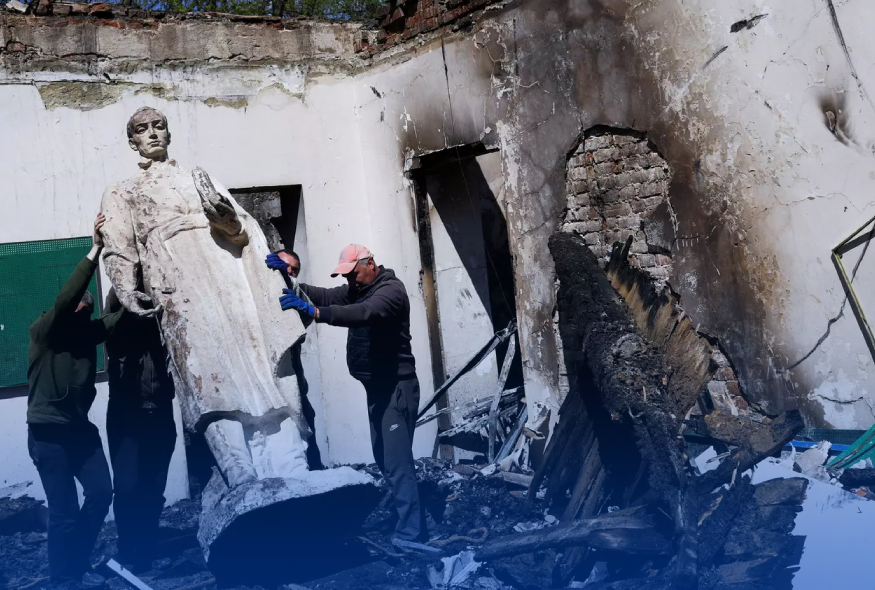
Upon my arrival, I was greeted by the director, Olena Tsyhanenko, who promptly led me to a display which featured photos recounting the story of the battles for Irpin. Although the library premises bore significant damage, now only photos serve as reminders of that time.
"Oleksandr Kysliuk used to come to us almost every day. He was very modest. He would spend hours reading, writing, and making photocopies. Shortly before the war, it occurred to me to take a photo of him at work. We only learned that he was a renowned scholar and translator when news of his death reached us," recalled the director, showing me a picture of a man in a jacket and glasses, with a pencil in his hand, leaning over stacks of books.
Kysliuk could translate endlessly, sometimes working up to twelve hours a day. In his spare moments, he enjoyed taking out a pocket dictionary and underlining unfamiliar words to better memorize them. It’s likely that the director caught sight of him doing such an activity before the onset of the great war."Oleksandr probably knew about twenty languages and was constantly learning new ones," Taras Kulyk, a friend of the translator, told me over coffee. "French was initially challenging for him. But after studying Latin, he realized that he could now easily master any Romance language."
Upon returning home, I searched for traces of Oleksandr Kysliuk in the YouTube archives. I wanted to hear how he spoke, study his gestures, and watch his expressions and smile. I came across the broadcast of the program "Are ‘dead’ languages really dead?" from 2003, where a much younger version of the modest man from the library photo poke about teaching Ancient Greek, Church Slavonic, and Latin, along with immersing himself in Ancient Hebrew: "When I delve into the study of other foreign languages, I initially feel a sense of distance, because I don’t know the history, culture, and art. I need to prepare myself beforehand." Kysliuk’s reverence for context likely stemmed from his education in history, which he received at Shevchenko University.
In the 2000s, Oleksandr Kysliuk translated Aristotle’s Politics and Thomas Aquinas’s Commentaries on Aristotle’s Politics into Ukrainian, which were published by Osnovy. He was the first to translate into Ukrainian the foundational work of the ancient Greek philosopher, which still forms the basis of discussions about political organization today. Thomas Aquinas’s Commentaries did not even exist in Russian translation, which, since Soviet times, due to colonial policy, significantly outnumbered Ukrainian translations of fundamental philosophical works.
Working on both books took nine years. He had to revise the texts time and again, taking into account reviewers’ comments. The scholar was inspired by the necessity of translation itself.
"I had to develop suitable terminology while steering clear of unnecessary borrowings from Latinisms, Hellenisms, and the like. Simultaneously, I aimed to modernize the translation, ensuring it resonated with contemporary audiences," the scholar told his friend Vitaliy Kvitka in an interview for Ukrainian Culture magazine. During the interview, Kysliuk also talked about his plans to translate historical chronicles from Latin that described Ukraine during the period of Bohdan Khmelnytsky and the Ruin. He eventually went on to do so.
In 2021, he was the first to translate the Polish chronicler Samuel Grondsky’s History of the Ukrainian-Polish War from Latin. It describes the liberation struggles of 1648-58 and testifies to the relevant historical problems of that time, including the origin of the Cossacks.
"One hundred copies of this translation were produced at a minimal expense," recalled publisher Taras Kulyk. "Oleksandr quickly sold them all to friends, acquaintances, and fellow scholars. Everyone needs primary sources, but not everyone can read Latin."
Kysliuk tackled not only classical works but also contemporary philosophy, including Dutch politician and philosopher Sybe Shaap, the founder of the theory of civilization Norbert Elias, German philosopher Karl Jaspers, and many others.
Kysliuk sought new approaches when diving into the study of foreign languages. One of them was to attempt to acquire the language as a child does. This method involves reading text in an unfamiliar language and gradually deciphering the meanings embedded within it. The level of understanding grows with each iteration, and a sense of the language and its logic emerges.
"It cannot be said that I have a thorough understanding of even the Ukrainian language, for I have been studying it my whole life," Kysliuk shared in a documentary film about him in the late nineties. "I cannot give preference to any particular language—they’re oceans of marvelous beauty, the entire history of people, the entire culture, the entire soul," the translator revealed the reason behind his restlessness.
**
Near the Holy Trinity Church, one of the oldest in Irpin, it was green and sunny. Serhii Miroshnychenko, a clergyman of the Orthodox Church of Ukraine and a long-time acquaintance of Oleksandr Kysliuk, greeted me with a smile and invited me for tea.
"This is how we usually had tea at the home of Mykola Budnyk, one of the founders of the Kyiv Kobzarskyi Tsekh, or "Kobzar Guild.". At first, we gathered in Zvirynets, and later at his residence here in Irpin. Some crafted banduras, some sang, while others came to chat or listen," explained the clergyman.
With the onset of the great war, ancient songs performed by the Choreya Kozacky increasingly began to resonate on the streets and in the homes of Ukrainians. This musical group, along with its founder Taras Kompanichenko, originates from the same Kyiv Kobzarskyi Tsekh. In the late seventies, a community of researchers, reenactors, and lovers of the kobzar tradition formed around the bandura player Heorhiy Tkachenko. Despite the repression of kobzars and bandura players, he miraculously preserved and transmitted the Sloboda tradition of recitations along with the accompaniment of the old-world diatonic bandura. In the mid-eighties, the Kyiv-based Kobzarskyi Tsekh became an informal center of free thought in the Ukrainian capital.
The meetings of Kyiv Kobzars resembled ancient Greek banquets of philosophers, where instead of lyres, they played the bandura. They valued freedom of thought and were modest in their daily lives. Similarly, the Kysliuk brothers arranged their dwelling modestly after purchasing a house in Irpin in the nineties. Instead of furniture, there were shelves cluttered with books and papers. Instead of a kitchen, there was only a stove with a pot of borsch.
Serhii Miroshnychenko, their instructor of ancient languages from the Kyiv Theological Academy and Seminary, remembered him as a sensitive person with a big heart: "We read the Holy Scripture in various languages, including Greek and German... There was no sense of routine in learning and the teaching was lively. If someone made a mistake, Oleksandr Ivanovych knew how to correct it so skillfully that the person could hardly make the same mistake again."
Kysliuk translated fundamental religious texts from the original. It is with these texts that the service is conducted today in the Orthodox Church of Ukraine, notably in the Holy Trinity Church in Irpin, which finally broke away from the Moscow Patriarchate after the liberation of the city from Russian tanks.
Interest in political discussions arose in the Kysliuk brothers back in their university days. In the early 1980s, a group of students from various faculties would gather secretly in an art studio in the Lavra. There, they engaged in discussions about the problems of non-Soviet history and possible ways for Ukraine to achieve independence. "Some suggested restoring the hetmanate, while others advocated for a president," recalled Olena Lodzynska, a researcher at the Museum of the Sixties and a classmate of the Kysliuk brothers.
After an attempt to set fire to a portrait of Brezhnev on Khreshchatyk Street, all the participants were detained by KGB officers. The Kysliuk brothers, along with others, were expelled from the university for "behavior incompatible with the title of a Soviet student." In the 1980s, such wording was often used by the authorities to label so-called "unreliable" citizens, depriving them of opportunities to receive education or find employment. After some time, Oleksandr managed to resume his studies and graduate from university. Pavlo’s professional path, on the other hand, was permanently ruined.
**
The fine March rain was still falling. Along with Taras Kulyk, we drove to the car cemetery, which contained vehicles that had been shot by Russian tanks, often with people and children inside. Right nearby was the graveyard where Oleksandr Kysliuk is buried. Rows of blue and yellow flags over the graves of warriors who died for the freedom of Ukraine served as a landmark. We turned right and came across a wooden cross with a photo of the translator. A rushnyk, stirred by the wind, covered the face of the deceased in the photo. Without speaking, we stood silently for a few minutes.
"The modest grave of a great man," Kulyk remarked. Modest was the translator himself. Like the ancient cynic, Kysliuk needed only a wooden barrel for life, just enough space for his books and manuscripts.
"In Latin, canin translates to dog. Therefore, cynics can be called both dog lovers and somewhat similar to dogs in their unpretentiousness. Oleksandr embodied these two characteristics. He loved dogs, cats, and birds. He constantly fed them, and he lived unpretentiously, like a bird," reflected Kulyk.
Work wasn’t a burden for Kysliuk but a form of relief. "I can't imagine my life without the work I do, without the research, teaching, translations, and acquisition of knowledge. Perhaps this feeling of freedom is the main thing. A person must be free to realize their potential," the translator shared in the documentary film.
In the rubble of his home, Pavlo Kysliuk welcomed me with a cup of coffee, which he had brought in a thermos. It was during such a coffee break that the Russians had singled out Oleksandr Kysliuk as their target. Along with him, his manuscripts and his dog burned—but not his work. It lives on in Ukrainian-language liturgical texts in the churches of the Ukrainian Church, on the shelves of personal and public libraries, in the minds of people who read his translations, and in the comments of colleagues who criticize, analyze, or continue his work. It also continues in the bright memory of loved ones, including his brother, friends, teachers, and colleagues. I absorbed a fraction of this memory along with the coffee from Pavlo’s thermos at the site of Oleksandr’s ruined personal translation laboratory, which had become a scene of a crime and a lost life.
Read also:
We need your help to create projects and materials aimed to defend freedom of speech, popularize Ukrainian culture and values of independent journalism.
Your donation means support for discussions, awards, festivals, authors’ trips to regions and PEN book publications.