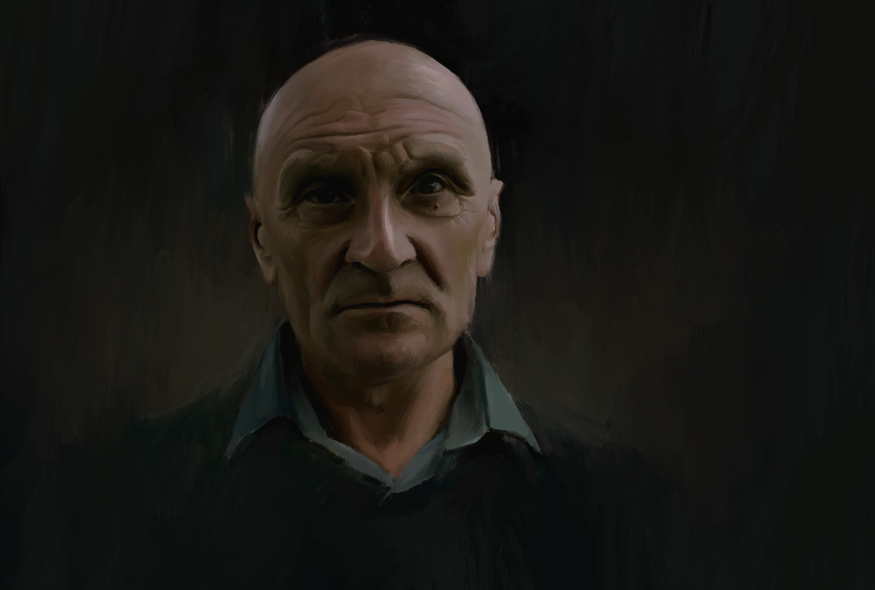
Oleh Kliufas: The Wandering Poet
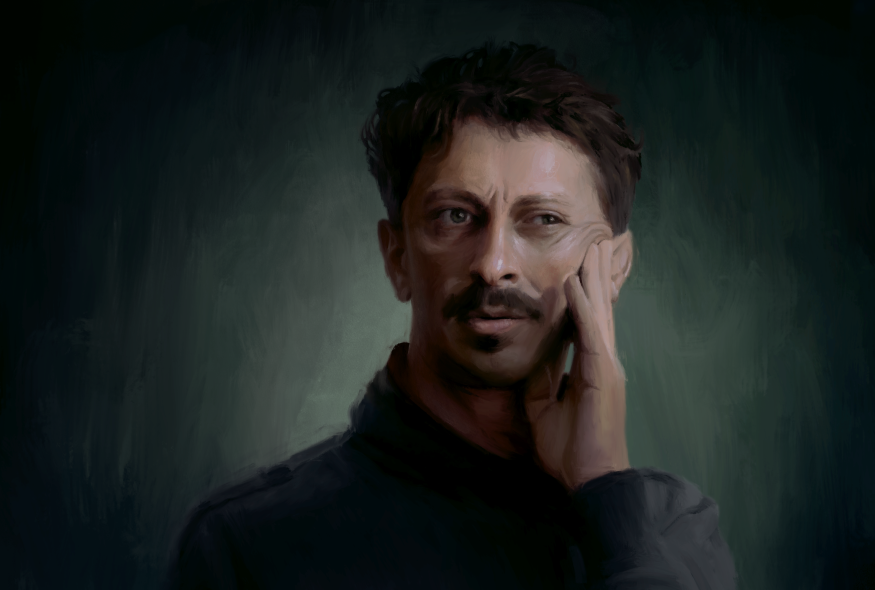
"This man was a daredevil. Brave men like him stick out the most, and then they are erased (from this world)," reflects Yurko Rybar about his poet friend Oleh Kliufas.
Oleh’s courage was evident in many things. First and foremost, it was apparent in his poetry. Visualizing words, Oleh eagerly tackled complex poetic forms and sometimes initiated new ones: beetles*, literal crabs*, and inexhaustibles*.
Oleh Kliufas wrote with great zeal. Translating a song was done in no time. Composing poems was a daily and anywhere affair. This was also true for his beetles—poems consisting of six syllables—that he continued to write down on paper in the bunker during the defense of the East. A piece of paper with an, at first glance, incomprehensible collection of words ended up in the hands of the commander:
Not alone
Oh you
You and you
The commander was truly alarmed: "What kind of code is this? Are you a spy?!"
As Oleh’s friend, the poet and artist Daryna Pazenko, explains, this poetry cannot be understood at a surface level. "It needs to be studied," she says. "Oleh’s perception of everything real and abstract was as ‘palindromic’ as his literal crabs: he loved to juxtapose, mirror, and turn thoughts upside down, viewing everything from a completely unique perspective."
Daryna believes that his work lacks gravity, which was particularly evident in a series of poems called "inexhaustible," where each word was Oleh’s neologism.
"The breadth of his views, emotions, and sensations couldn’t fit within the confines of a single Universe, so he created his own, filling them with special meanings and nonsense," Daryna shares.
**
Oleh was a researcher from early childhood. He began reading at the age of four when he would sit in his playpen surrounded by books. As soon as he was a bit older, the boy loved to sit on the doorstep and read aloud. Usually, a small audience of chicks and ducklings would gather around him.
That same passion for adventure and discovery led young Oleh to ride his bicycle to his relatives’ village, which was fifty kilometers from his home. He was confident he would reach his destination because he remembered the route well. The boy was accidentally spotted by a teacher who lived in a neighboring village. Recognizing Oleh, she had him turn around and accompanied him back to his parents.
He then skipped from the third grade straight to the fifth because he was an excellent student. "He would have just been bored," explains his brother Ihor.
Oleh eagerly absorbed knowledge, showing no aversion to any field. According to those close to him, he thought beyond the confines of systems and was open to new perspectives. However, Oleh enjoyed debating and asking provocative questions. He was interested in showing his interlocutors a broader view of things. He would often stay up late into the night with his father at family gatherings, discussing history, philosophy, or any other topic. "When everyone else went to rest, they would either continue or just begin their discussions," says Anastasiia Kliufas, Ihor’s wife.
Oleh did not like accumulating possessions except for interesting books or something unique. He valued his rich library, which included world and Ukrainian literature, foreign editions of philosophy and history books, encyclopedias, children’s books, various dictionaries, self-teaching materials, essays, and postcards. Ihor and Anastasiia found a printed article about Jorge Luis Borges in his collection. It mentioned that Borges dreamed of becoming a book after his death.
"To partially understand Oleh, one would need to reread all the books in his library. They are a flow of ideas, a part of him," says Anastasiia.
Oleh also enjoyed experimenting in the kitchen, such as when it came to mixing ingredients. Once, he posted a photo of his dish on social media and captioned it: "Meatball soup with thyme, toasted sesame, and Apulian-style tangerine zest." His friends were amazed by such recipes, only for Oleh to later admit that he had invented most of them himself.
"If Kliufas made borscht, it would definitely have cherries, cream, or pineapple. He was a storyteller. But a truthful one," explains Daryna Pazenko.
According to Yurko Rybar, Kliufas had a habit of walking on the edge. He might shout something, perform like an actor. However, he did not polish his words or images—they were all improvised. That’s why, in the military, Oleh earned the call sign "Jazz."
"Jazz is all about improvisation. The essence is to provoke, to follow your own line, but to twist things around. It’s about tossing words back and forth," explains Yurko Rybar.
**
The easygoing guys from the band Myklukho Maklai once invited Oleh to a rehearsal. There, they discovered, "Oh, you write!" Oleh volunteered to translate an American shanty—a lively song sung by sailors drifting down the Mississippi River. He brought the translation to the next rehearsal.
Oleh took on niche songs in various languages, like from English and Spanish to Hungarian and Lithuanian, even though he wasn’t fluent in them. "Oleh was a phenomenon. He didn’t need to be fluent in a language to translate. Yes, he had various dictionaries, but he had a keen sense of the rhythm and meaning of a song to create a quality literary translation. It was about intuitive feeling, a gift…" his brother marvels.
Oleh could have composed his own sea shanties. "He literally stepped off the boat into our midst, very poetically and characteristically so," recalls Daryna Pazenko of her acquaintance with Kliufas during a river rafting trip.
For the last few years, Kliufas made it a habit each summer to don his distinctive cowboy-like hat and set out on adventures along the winding Dnister River. He spent about two weeks with his sons, Maksym and Severyn, on an ethnographic expedition with the Society of the Lion. Although, as was often the case with him, he would spontaneously decide to extend the journey. There, among like-minded people, he also sang: a video exists where Oleh sings a Lemko piece with a low jazz voice while his friend writes down and adds to the lyrics.
Oleh carried himself proudly in this world. He wasn’t afraid to express himself. For example, he would dance somewhat awkwardly but freely at musical performances or parties—St. Vitus’ Dance, as he called it. Or he would comment on everything he saw in a stand-up style, bringing joy to everyone. Or he would hum Portuguese bossa nova, which he had translated himself:
You, with your music, lose the main thing:
that even there, where there is no tone or harmony,
the heart beats painfully in the depths,
that even there, where there is no tone or harmony,
there is a warmth at the bottom of the heart.
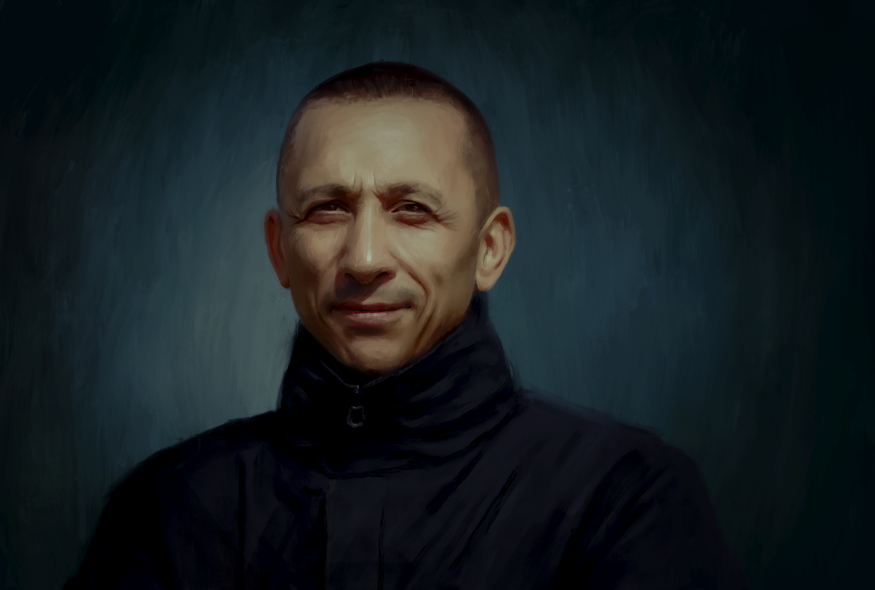
"Expressiveness—that was Oleh. An expressive surname, an expressive appearance. Small, narrow-shouldered, rather solid—compact. Collarbones sloping downward, straight back. He was like a nail. A long, slightly duck-like nose. Enormous, bulging eyes," describes his friend Yurko Rybar.
When he learned that Oleh would be laid to rest in Mostyska, he was surprised because it turned out Kliufas wasn’t from Lviv! Everyone in the Lviv intellectual circles knew him. "To write, one has to be among people," Yurko observes.
So Kliufas sought experiences and impressions. Life is short; one needs to make the most of it. He visited the center of Lviv more often than he did his own home. He was frequently seen outside the jazz club at Kryva Lypa or on Armenian Street at places like Dzyga, Facet, or Facetka. The band Miklukho Maklai even called Facetka their "parish." They would gather there and sing their parish song with Oleg:
If I had eagle’s wings,
If I could fly…
Another remarkable aspect of Oleh was his ability to be organic in different environments while remaining true to himself. He found common ground with esteemed performers from the Prometheus choir, the underground art scene, children, and soldiers. He would move seamlessly from one environment to another. Oleh used to say, "If a word is a touch, then a phrase, a conversation, is a contact."
Without Oleh, Lviv, according to Daryna Pazenko, has quieted down. When Kliufas went to the front, the legendary jazz club LV Cafe that he loved also closed. "We used to say among ourselves: jazz left Lviv," remarks Daryna.
**
Six months before the full-scale war began, Kliufas wrote in a poem, "At war, like at war":
You speak
heart to heart
but in those hearts
mines run through
in war
as in war
sometimes, you write it
sometimes not
In February 2022, joining the Territorial Defense of Lviv was nearly impossible. But Oleh Kliufas still achieved his goal. By spring, he was already undergoing training, and later, from the front lines, he encouraged his friends to join the army. He told Yurko everything could be learned in military service: "Well, look at me. I’m not Rambo."
Oleh joined the army without unnecessary bravado. He understood that, like all mortar soldiers, he was taking a risk, as he was an essential target for the enemy. But someone had to fight.
In the Bakhmut direction, he had the ability to calm down friends in the rear. During the war, he managed to create numerous new works and translations. He also didn’t miss the chance to participate in the artistic community SvitOhlad house concerts, albeit remotely. His brother believes that it was his creativity that kept Oleh afloat.
What also helped Jazz was his return to civilian life. In ten days of leave, he had to do everything. "When Oleh came back, he lived with a Skovoroda-like joy of life and inspired us with his vitality," recalls Daryna Pazenko.
Oleh liked to add the phrase "But that’s not certain" to everything. Once, when a conversation with friends unexpectedly turned to epitaphs, they joked: "Oleh, one day in the distant future, you should have that written on your tombstone." He considered it and agreed: "Here lies Oleh Kliufas, but that’s not certain."
A beetle, or poetic beetle, is a three-line poem with six syllables (2–2–2). The genre got its name because its structure resembles the morphology of beetles: beetles have three pairs of legs, just as a poetic beetle has three lines of two syllables each.
A palindrome (palindromic verse) is a word, number, set of symbols, phrase, or verse that reads the same in both directions (left to right and right to left).
Neokhopia is a poetic genre initiated by Oleh. These are poems composed entirely of neologisms.
Read also:
We need your help to create projects and materials aimed to defend freedom of speech, popularize Ukrainian culture and values of independent journalism.
Your donation means support for discussions, awards, festivals, authors’ trips to regions and PEN book publications.