Yuriy Kostyk: A Historian Defending History


"Mykhailyk, pour the cement into this corner, and I'll smooth it out so your toy car can drive straight," says Yuriy, crouching down as he explains to his six-year-old son, who listens attentively.
The Kostyk family is pouring a concrete floor in a room, and everyone is working together under Dad's guidance. In the yard, cement is being mixed in a basin. Mykhailyk fills a small bucket with it and follows his dad into the house. Buddy, their shaggy black Hovawart, runs back and forth in his pen nearby. Three-year-old Danylko quietly tosses grass into the cement along with the sand and gravel, but Dad only smiles because he never scolds—that's just his nature. Nine-year-old Marta is carrying the torn-up floorboards from the house and stacking them in a pile. She's doing her best, trying to carry as much as she can because she's the eldest of the children and, therefore, "strong."
"Sweetheart, don’t take so much!" Yuriy rushes over and takes most of the load from her. "Be careful, watch out for the nails."
Marta nods in agreement, but the next time she grabs even more, licking her upper lip just like her dad (a copy of him!). "What a sly little fox!" Yuriy smiles at his wife, Sofia. She's busy in the kitchen with Grandma Mariia but occasionally runs out to their cozy yard, bathed in the May sun, to snap some photos of the scene as a keepsake.
"I took a lot of pictures back then," says Sofiia Kostyk three years later. "Now that Yuriy is no longer with us, I realize how meaningful they are."
***
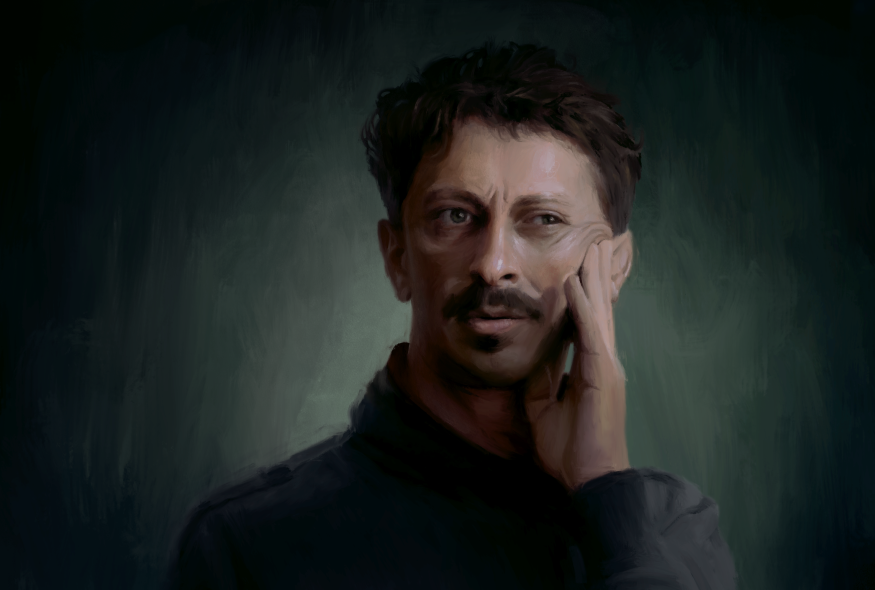
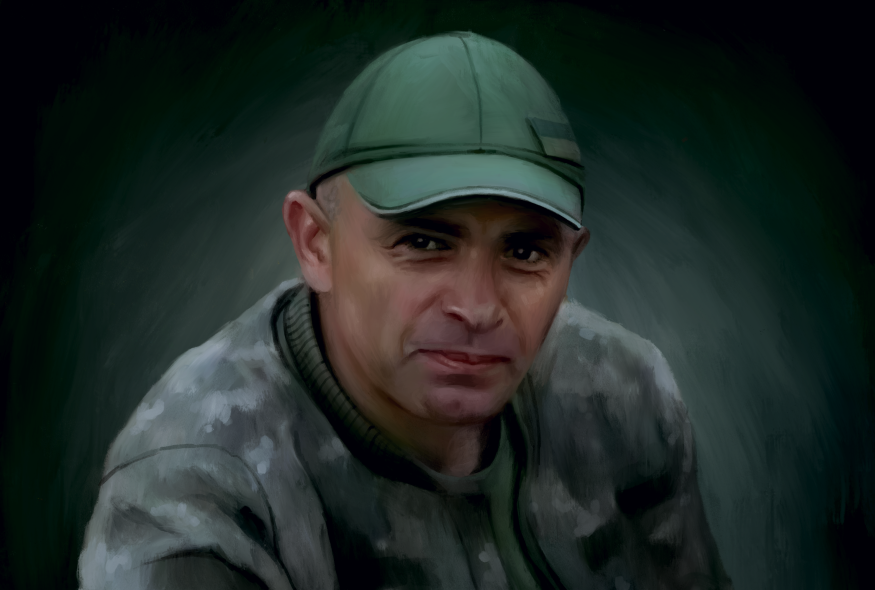
Yuriy Kostyk, call sign "Hero," was killed on October 16, 2022, during a combat mission in Kharkiv region. Yuriy was a serviceman in the 80th Separate Air Assault Brigade of the Air Assault Forces of the Armed Forces of Ukraine, a company commander, and by education, a historian. He had been fighting since the summer of 2014.
"He couldn’t have done otherwise," his family says. From the beginning of his service, Kostyk dedicated himself entirely to his work. He took all the tools from home, used his own car extensively, and obtained supplies for his unit because "no one else would do it."
"His enthusiasm kept the entire repair unit running!" says Andriy Brevus, a brother-in-arms and a close family friend. "But most importantly, Yuriy knew how to organize people. He brought civilian management approaches into the army, assigning tasks to subordinates according to their abilities."
The soldiers remember him as a wise and kind commander, the likes of whom are hard to find in the military. Andriy Brevus calls Yuriy "a man with a deeply civilian soul, too good for war, though no one is made for war."
Kostyk’s service record noted that he was "attentive to the problems of his subordinates, maintained proper conduct with everyone, and was able to understand the uniqueness of each person."
His friend, Serhiy Kis, also recalls this "pedagogical streak" in him. "Yuriy would immediately conduct a psycho-emotional diagnosis of his conversation partner," he says. "His experience leading a group of servicemen was evident." Kostyk also had teaching experience, having lectured for four years at the Danylo Halytsky Lviv National Medical University.
When Serhiy was involved as a criminologist to document crimes, he met Yuriy in Izium. "It was surprising to me that this man (a current serviceman!) was concerned about my mental health while watching me work," he recalls. "Hang in there," Kostyk later wrote to his friend in a message. "There’s no end to this work the further east and south you go."
***
"We lost an outstanding historian," reflects Kostyk’s aunt, Yaroslava Melnyk, Doctor of Philology. "He was a historian with a sense of style, clear principles, and values, who never succumbed to passing trends."
Aunt Yaroslava helped Yuriy’s mother care for him from a young age—his father died when the boy was eleven. "Aunt Slavtsia," as her nephew called her, became his guide into the world of knowledge and books. "Did you bring any?" Yuriy would ask her from the doorway about new books when she returned home from her job at the Ivan Franko Museum in Lviv.
In the Junior Academy of Sciences, Yuriy became fascinated with Count Mykhailo Tyshkevychz, a diplomat, philanthropist, and aristocrat concerned with the Ukrainian cause at the turn of the 19th and 20th centuries. This non-media-savvy and modest, yet visible and influential figure was nominated three times for the Nobel Peace Prize. It was as if Yuriy had found his double and mentor in Ukrainian history. He later chose Tyshkevych as the subject for his dissertation, which he never completed due to the war.
It was Aunt Yaroslava who first took the high schooler Kostyk to the Ukrainica Department of the Vasyl Stefanyk Lviv National Scientific Library of Ukraine. He would later work there for ten years.
"He liked it here," say his colleagues from the Ukrainica Department, "because everything smelled of antiquity." Kostyk especially loved the storeroom, with its forest of shelves reaching up to the ceiling, crammed with books. His colleagues recall that he wrote academic articles faster than anyone else, yet he never flaunted his knowledge or sought accolades.
"If it weren’t for Russian aggression," says Kostyantyn Kurylyshyn, head of the Ukrainica Department, "Yurko would have thrived as a scholar. His thesis work in the Junior Academy of Sciences on Count Tyshkevych could easily have become the foundation for a doctoral dissertation."
Everything changed after the Revolution of Dignity. "Yuriy came back a different person," his colleagues recall. "He lost interest in pursuing academic work." His sense of civic duty called him.
***
"Hi! I'm alive and well, everything's good, but I'm so sick of all this machinery and pasta, I want some varenyky. That's it, bye-bye. Yurchyk." This is how sixteen-year-old Yuriy signed a postcard from Italy to his mom during a trip to Rome. The card depicted the Matilde Tower in Viareggio illuminated by evening lights, which somewhat resembled Lviv's Powder Tower.
"He loved varenyky and the saying that he was sick of something," recalls Yuriy’s's mother, Mariia. "He loved historical museums, especially the 'Arsenal,' and he adored reading, especially historical detective stories and science fiction. He also loved Christmas and always fried doughnuts himself for the Holy and Generous evenings."
In eighth grade, the boy confidently told his mother that he was "going to elevate spirituality," so he went to the Ukrainian Greek Catholic Lyceum named after Klymentiy Sheptytsky, served in the church, and even had a recommendation for seminary, though he never pursued it.
"He always had his own vision," says Mariia, "and he was also very principled." She remembers how her son refused to go caroling to those he didn’t like, including people who used bad language. "Yuriy never befriended hypocrites—he couldn’t stand them."
In 1990, on the anniversary of the Unification Act, the boy traveled to participate in the Human Chain of Unity in Sokilnyky. Grandma Stefaniia had sewn a flag from old shirts, and he took it with him to the event.
From his great-grandfathers, Kostyk inherited skilled hands—one of them had been a carpenter with his own workshop. "By the time he was ten, Yuriy already had a carpentry set and made shelves for his beloved collection of toy model cars," says Mariia. That love of craftsmanship was passed down to his son, Mykhailo. One day, Kostyk gave his son an electric screwdriver—it became his favorite toy, and he almost slept with it. Now Mykhailo has his own professional toolsets, gifted by his father's brothers-in-arms.
***
Kostyk signed a contract with the military in 2016, fully aware of what war meant—he had been fighting in Donetsk and Luhansk since 2014. "Yuriy, maybe you shouldn't do it? You've already been on the front lines, let other guys go now," his aunt asked him. To which he replied, "I'm not doing this for others, I'm doing it for myself."
In July 2021, in a TV segment about the brigade’s return from the Joint Forces Operation zone, Kostyk shared that his decision to serve was more important than his previous job. Danylko, whom he held in his arms, touched his father’s beret with his finger and asked when he would have such a "hat" too.
In the video, you can see ten-year-old Marta hugging her father tightly. "I was so happy I could have just flown up to the sky and looked at my dad like a Hero," she admits in an interview.
During our conversation, Kostyk’s mother, Mariia, brought out her son's award, the "Honorary Order of St. George," posthumously presented to the family the day before. She both understands her son's choice and feels the consequences for the family: "He will no longer be able to explain to his children how the Ukrainian state was formed. He won’t be able to teach them to love Ukraine, and you can’t learn that from books. He won’t be there to support them as a father."
***
In June 2023, the staff of Bohdan Khmelnytsky Park in Lviv initiated the Trees of Memory campaign. Among the trees planted in honor of fallen heroes is Yuriy Kostyk's "Persian ironwood." According to legend, the Persians used stakes from this tree against Damascus steel sabers because of its dense and heavy wood.
The whole family helped plant it. In a video shared on social media, Mykhailo can be seen carefully watering the sapling. Since then, the Kostyk family often visits the park for picnics. "This way, the children feel that their father is present nearby, in this park," says Sofia, "they can cherish his memory by caring for the tree." A picnic blanket is always ready in her car.
Yaroslava Melnyk plans to write a book about her nephew, collecting testimonies from his friends and comrades, as well as photographs and archiving his academic articles. After Yuriy's death, she wrote an essay about him on the website Zbruch—a final conversation with her nephew.
Nearly two years have passed since Hero’s death. Yet almost everyone I spoke to about Yuriy Kostyk talks about him in the present tense, as if he’s still among us. Sofia Kostyk continues to build the house whose foundation her husband laid. Marta plays the guitar her father once gave her (now she has three); the youngest, Danylo, practices karate and gymnastics, and the middle son Mykhailo plays the drums, always crafting something and asking his mother, "Am I doing it like Dad?"
Read also:
We need your help to create projects and materials aimed to defend freedom of speech, popularize Ukrainian culture and values of independent journalism.
Your donation means support for discussions, awards, festivals, authors’ trips to regions and PEN book publications.