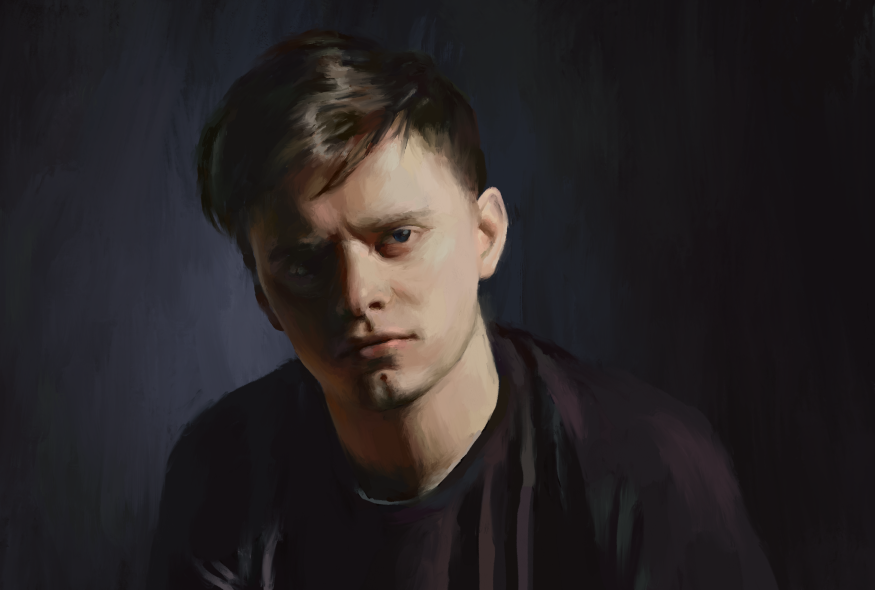
Kostiantyn Starovytskyi: Maestro

The slender figures of the blue and yellow flags fluttered in the cold sun. On the Heroes’ Alley in Brovary, they buried the bassoonist and conductor Kostiantyn Starovytskyi, who died on April 4, 2023, while performing a mission near Kramatorsk. Many people gathered for the funeral: military uniforms mixed with black jackets and the pristine white robes of priests. In the flower-adorned coffin, Kostiantyn clasped a cross, and next to him lied the conductor’s baton. People around kneeled. Gunshots rang out as Kostya’s comrades-in-arms paid their final respects. Applause followed, as this was how musicians were traditionally bid farewell. Oleksandr Miyal, the commander of Kostya’s unit, looked with surprise at the journalists who had arrived. "Why is there so much press here?" he asked. "Don’t you know who he was?" wondered Kostya’s friend and colleague Halyna Dub. Oleksandr shrugged in bewilderment, "He’d mentioned playing in the orchestra, I think." Halyna shook her head—of course, he hadn’t told them anything; that was typical Kostya.
Kostiantyn Starovytskyi, embodied traits that, at first glance, were not very typical of a typical conductor–modest and restrained, sensitive to others and indifferent to his own status. He did not seek power and recognition, but he loved music and did not shy away from hard work. He spoke sparingly about himself: in his unit, they didn’t know he conducted an orchestra; in the theater, they didn’t know he dug trenches. "Even our parents didn’t realize for nine months that he was serving in the army," recalled his sister Svitlana. Kostya seemed to compartmentalize his life, gently separating each part from each other and never claiming a leading role anywhere.
His journey on the path of conducting was long. Ten years in music school, five in the conservatory, three as an assistant. Afterward, he played in various orchestras, sometimes found himself unemployed, occasionally doubting himself, yet immediately enthused by a new project. No matter which orchestra he joined—whether at the Kyiv Opera in Podil, the Presidential Orchestra, or as part of the Kyiv-based Lords of the Sound, performing hits from movies—he always organized his own wind quintet or bassoon quartet. "He wanted to do something of his own. It gave him the opportunity to embody his own vision of music and organize the world, at least in notes and scores," recalled his classmate Yevhen Slabenyak. Even in his student years, shy and somewhat reserved, Kostya had already felt the desire to lead, inspire, and guide with the wave of his baton.
His first major conducting work was the comedic opera "Rita" by the Italian composer Donizetti, for which Kostya personally transcribed the score for a woodwind quintet. The premiere took place in 2015 at the Theater for Young Audiences on Lypky. "At that time, we had the idea for the conductor and musicians to become characters and play in the opera alongside the actors," said director Lada Shylenko. Kostya immediately embraced this idea and even wrote lines for his musicians. They called him "maestro," and he mischievously winked at them, saying, "Let’s play louder, gentlemen!" The plot of the opera unfolded in a hotel room, where the main characters were entangled in a love triangle. "I remember how Kostya was concerned that he forgot to put on hotel slippers before going on stage," smiled Halyna. He took the acting very seriously.
In the theater, there was almost no task that Kostya wouldn’t eagerly take on. As a conductor and stage director, he was responsible for the orchestral part, but he willingly stayed to rehearse with the musicians, whom he understood and felt "almost like a second skin," recalled Lada. He gladly helped people, and they reciprocated in kind. When it was necessary to assemble the orchestra in a few hours, musicians readily responded to his invitation. Just as easily, he organized the transportation of set decorations or negotiated with the theater management. When veterans of the Russian-Ukrainian war started attending the theater, Kostya took it upon himself to arrange the seating, wanting people with disabilities to be able to move comfortably through the hall. "Once he wrote to me: look, it’s cold in the theater, there’s no heating, so I bought a canister of gasoline for the generator," recalled Halyna. He didn’t have to do it, but he did because the theater and music were more than just a job to him. And when the performances ended, it was Kostya who appeared behind the scenes with a bottle of champagne—he had everything thought out.
Kostya loved his craft, but, like most musicians, he understood that the culture of classical music in Ukraine was in decline. Many projects and ideas faced a lack of funding. "They told us that no one was interested in classical music or that kids wouldn’t want to listen to opera," recalled Halyna. Kostya believed otherwise. Alongside Yevhen Slabenyak, he dressed in ancient tunics and wigs and organized small performances for children at the theater entrance. Ahead of his time, he realized that the new generation could be captivated by shorter, one-act plays, for which he gladly wrote orchestrations. But the challenges did not end there.
For a long time, the Ukrainian opera scene suffered from total russification. As early as 2013, performances of Italian composers at the National Opera were presented in Russian translation. Kostiantyn tried to combat this, translating the librettos of "La Cenerentola" and "Il Signor Bruschino" into Ukrainian. He regretted the loss of so many works by Ukrainian composers during the repressions of the 1930s. "Kostya refused to believe that the opera singer Solomiya Krushelnytska was perhaps the sole representative of the Ukrainian opera scene and believed that we should search for the relatives of composers and sift through archives to find the lost layer of our culture," recalled his wife, Snizhana. He’d dreamed of forming his small orchestra with Ukrainian musicians and touring Europe so that Ukrainian classical music would become a pan-European brand. But the same enemy continued to stand in the way one hundred years later, destroying Ukrainian culture and claiming the lives of its artists.
Kostya received the news of the full-scale invasion calmly, without showing any emotion. "I'll go put the kettle on," he told his wife on the morning of February 24. After that, he went to the military enlistment office. "He said he was going for territorial defense," recalled Snizhana. "But later, he admitted that he took the oath, and I realized that he’d joined the Armed Forces of Ukraine."
His patriotism was never over the top: it contained sacrifice, quiet nobility, and music. In 1991, when Ukraine declared its independence, eight-year-old Kostya walked the streets of Kherson, singing the Ukrainian anthem. "His mother was a bit nervous then because such things weren’t done in the russified Kherson, but Kostya said that no one would be offended by his singing because the melody was so beautiful," recalled Snizhana. He was a tender, compassionate child—before his passion for music, those close to Kostya even speculated that he might enter the seminary. It was hard to imagine that he would ever take up arms. "He had something quixotic about him," smiled Snizhana. He was a graceful knight in a world where chivalry had become a dusty legend; a gentle figure in the attire of ancient music, telling children about modesty and dignity, duty, and honor. But when the time came to act, he did so calmly and without hesitation—near Brovary, on the Belarusian border, in Kharkiv Oblast, in Kramatorsk, and near Bakhmut.
Kostya didn’t talk much about his military service. Instead, he joked a lot, sent photos of hearty field meals and army cats, and always asked about his daughter Eva and the dog Dusya. "Actually, the dog’s name is Dafna, but Kostya thought it was too pompous a name for a dog with such a temperament," laughed Snizhana. Kostya and Dafna were recognized by all the dog lovers in the district—during evening walks, he would hum to himself and practice conducting gestures. Every summer, when their large family of brothers, sisters, nieces, and nephews gathered at their parent’s dacha near Kherson, Kostya and Dusya moved from the crowded house to a canvas tent in the garden. There, on the banks of the Dnipro, among trees and reeds, he felt happy. He had a great love for all living things: he saved an injured dog, giving money to the vet. He took care of abandoned vases in the stairwell–jokingly called "gallows"–and even pitied a spider spinning a web in a trench in Chernihiv Oblast. During his service, stray cats and dogs continued to be drawn to Kostya like a magnet. He enthusiastically conducted for them, too. "The last photo he sent me a few hours before his death was from a muddy trench where he’d sculpted a dog’s face out of the ground. ‘Here,’ he wrote, ‘pass on my greetings to Dafna’," recalled Snizhana.
Animals and flowers, children and music, orchestration until dawn, and gentle laughter behind the scenes—Kostiantyn Starovitskyi filled his life to the brim with love. Although he himself probably would never have said so—it would have been too grandiose for someone with such a character. He would just smile—empty, nothing to talk about—and walk further through the twilight field near Brovary, humming a melody known only to him.
This text became possible thanks to Kostiantyn’s spouse, Snizhana Starovytska, and his sister Svitlana Starovytska, as well as his friends and colleagues Lada Shylenko, Halyna Dub, and Yevhen Slabenyak.
Kostiantyn Starovytskyi was born on October 30, 1982, in Kherson. In 2018, he graduated from the National Music Academy of Ukraine with a specialization in opera-symphonic conducting. He worked at the Kyiv Municipal Academic Opera and Ballet Theater for Children and Youth, as well as in the State Academic Variety-Symphony Orchestra. He was the chief conductor of the Chamber Opera Festival "Opera Weekend" and directed various operas on different stages in Kyiv, including Gaetano Donizetti’s "Rita" (2015), "Don Pasquale" (2019), Gian Carlo Menotti’s "Medium" (2018), and Giacomo Puccini’s "Gianni Schicchi" (2019). He conducted operas by Giuseppe Verdi, Sergei Rachmaninoff, and Semen Hulak-Artemovsky with the orchestra of the Opera Studio of the National Music Academy of Ukraine. In 2021, he received an invitation to the Berlin Opera Academy as an assistant conductor. He leaves behind his wife, Snizhana, and daughter, Eva. In February 2022, he joined the Armed Forces of Ukraine. He perished on April 4, 2023, in the direction of Kramatorsk.
Read also:
We need your help to create projects and materials aimed to defend freedom of speech, popularize Ukrainian culture and values of independent journalism.
Your donation means support for discussions, awards, festivals, authors’ trips to regions and PEN book publications.