Andriy Fylypchuk: Preserving History
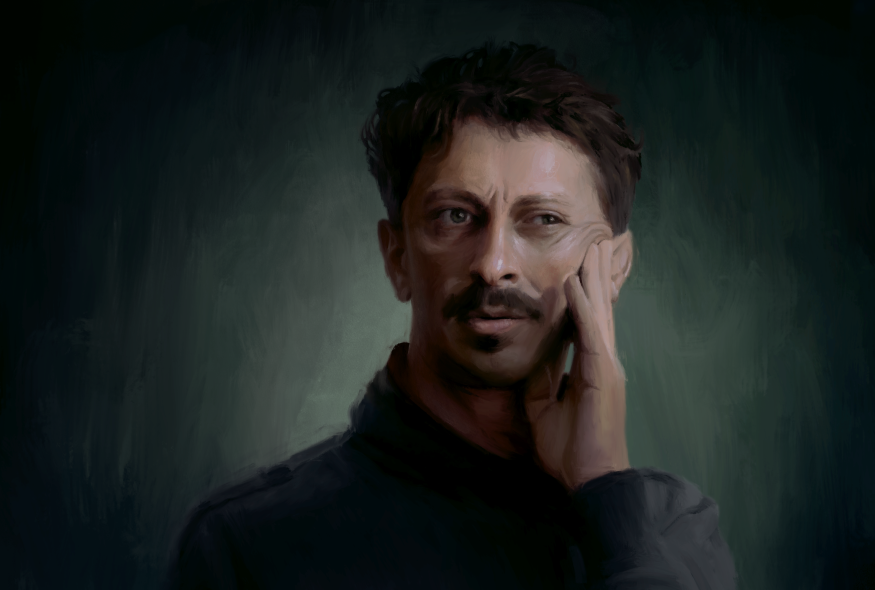
The sun was setting over Plisnesko. Cool forests exhaled mist, and the boys from the archaeological expedition had already taken off their T-shirts, throwing shovelfuls of soil. Among them was Andriy Fylypchuk, a student from the History Department. He smiled, squinted at the sky, and took a drag from his cigarette.
The day at the excavation site of an ancient Slavic settlement started early. At 5:30, they lit a fire. At 6:00, they began preparing breakfast, and by 8:00, they were already at work. Andriy dug, joked, and never stopped talking, not even to catch his breath. At the same time, he ensured that everything was done correctly. The walls of the excavation site had to be perfectly even, the stakes identical, and the ropes delineating the area straight.
After lunch, work at the excavation site came to a halt, but Andriy didn’t stay idle. He invented sports competitions for the expedition: soccer, volleyball, swimming in the pond, and the occasional battle with wooden shields and swords reminiscent of ancient times.
"It’s like a sports camp here, not a scientific expedition," laughed his future wife, Halyna.
In the evening, under the stars, they set a large table and lit candles. Someone brought a guitar from the tent, and others examined the day’s finds, including small fragments of pottery often encountered during excavations. Andriy lit a pipe and said:
"Imagine how many people would have had to stand in defense of Plisnesko to repel the attack of Volodymyr Sviatoslavovych?"
This question sparked a lively conversation that didn’t quiet down until late at night. They talked about ancient wars, archaeology, and the history they felt beneath their feet. But in the end, it all came down to one thing.
"Always Plisnesko," said Halyna. "He always wanted to talk about Plisnesko."
**
The ancient Ukrainian settlement of Plisnesko is located near the village of Pidhirtsi in Lviv Oblast. During its heyday in the 9th-10th centuries, its area reached 225 hectares measured along defensive lines, far exceeding the size of ancient Kyiv during the time of Kyivan Rus. Later, Plisnesko was captured by Prince Volodymyr Sviatoslavovych, and in 1241, it was destroyed by the horde of Khan Batu. Exploration of the settlement began as early as 1810. Andriy’s father, Mykhailo Fylypchuk, undertook excavations in the 1990s.
Andriy first joined the excavations of Plisnesko at the age of fourteen and became devoted to it for the rest of his life. "Every soul lost to ancient history that has been to Plisnesko cannot erase it from their heart," he wrote.
"If you spent just one day at Plisnesko," said Andriy’s colleague Oksana Yakubovska, "you would understand why we all became fixated on it."
Plisnesko, as Andriy described it, was a "treasure," a "pearl," a "cornerstone" on which one of the largest Slavic settlements in Europe arose, and pagan shrines transformed into a Christian church. It was the legacy of Andriy’s father, who had dedicated his life to Plisnesko, and the legacy of the entire Ukrainian people, whose history Andriy uncovered in the layers of the dark soil.
"He had a theory," recounted his friend and colleague Natalia Stebliy, "that the population of the Ukrainian Carpathians stood at the origins of our statehood. He believed that the significant settlement of the Slavs—the ancestors of modern Ukrainians—began from here, not from the Upper Dnipro region, as is commonly said". Always polite, he was ready to defend his theory tirelessly, arguing with senior scholars from Kyiv and Lviv.
"Perhaps he was right because there are many theories about the ethnogenesis of the Slavs. But Andriy didn’t want to hear about them," Natalia smiled, recalling how passionately Andriy would present his ideas, chain-smoking one cigarette after another.
Andriy knew that he had to defend his history and stand up for his beliefs. He often caught metal detectorists who illegally came to the site to steal golden fibulae and other treasures from the excavations.
"It hurt him a lot," shared Volodymyr Shelep, a friend and archaeologist. "He believed that these treasures belonged to the entire nation and that without context, they meant nothing. At Plisnesko, we were researching the entire history of ancient Slavs, for which there are almost no written sources—their dwellings, ceramics, burials, towers, and ramparts. Looters were just tearing golden pieces out of our history."
There are many torn pieces in Ukrainian history. The Bolsheviks transported a vast collection of furniture, paintings, and weapons from the Pidhoretsky Castle near Plisnesko, which were scattered across Russian museums and archives. According to Volodymyr, the Russians were trying to distort historical truth to their advantage: "They tried to stitch their history with Ukraine and Belarus to solidify the myth of three fraternal nations."
The body of research on Plisnesko conducted by Ukrainian archaeologist Yaroslav Pasternak miraculously survived the Soviet purges. Pasternak himself emigrated to Canada, taking with him a unique bone plate depicting a warrior that he had unearthed at Plisnesko in 1940. When Ukraine regained its independence in 1991, the plate returned home. Andriy said that, for him, it was the most valuable archaeological find.
His passion was the wide defensive ramparts that encircled the settlement—the ancient Slavs had mastered the art of military architecture. They constructed earthen fortifications with palisades and paved them with stones.
"We could use such fortifications in the east now," sighed Volodymyr.
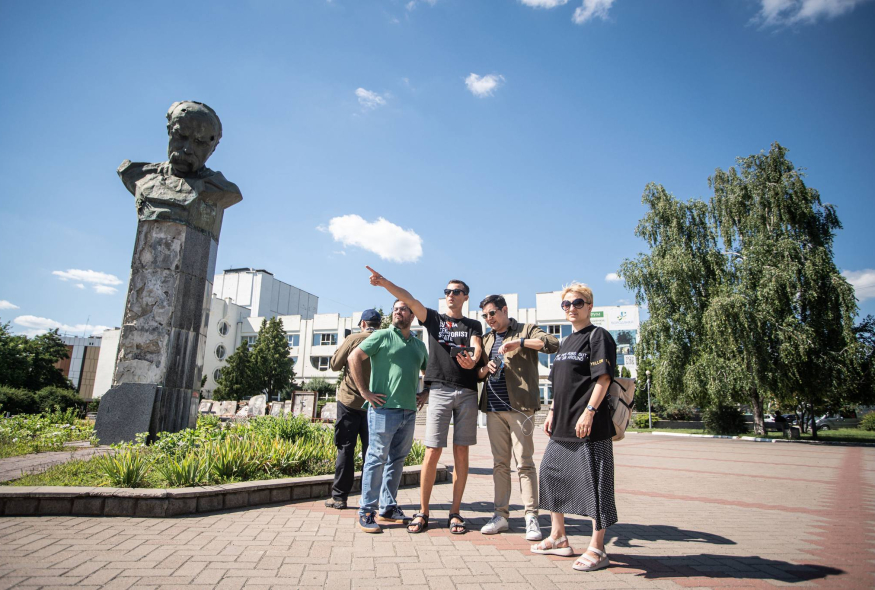
During his excursions around Plisnesko, Andriy would often linger by the defensive ramparts, turning to his audience during a tour and saying, "Imagine…" He proceeded to paint a picture for them of fortified towers and embattlements from which the armed residents of ancient Plisnesko watched the approaching army of Volodymyr Sviatoslavovych.
"His tours were a masterclass," said Father Vitaliy Barabash, who, along with Andriy, explored the first Christian burials in Plisnesko. "He was always elegantly dressed in a white shirt and a red tie. He spoke passionately and leaned toward people as if he wanted to pull them into the past with him. He would transport himself from the 21st century back to the 9th in an instant, confidently bridging the gap for his listeners."
"Many people don’t know their history," added Father Vitaliy. "They don’t yet know how much they love it. But if Andriy told you about it, you couldn’t help but love it."
Excavations in Plisnesko were sustained by love. After all, archaeology in Ukraine is hard and impoverished work that one must love with all their heart to have to dedicate their life to it.
The romance of student excavations disappeared relatively quickly. Andriy’s father passed away in 2016, and Andriy took over the responsibilities of leading the expedition. He constantly had to think about matters like how to move field equipment and transport the findings from the excavation site, where to accommodate students helping with the digging, and what to do when students were not around; where to properly store provisions so as not to eat only buckwheat for a month; where to dry soaked clothes; where to charge phones; and, of course, where to find the money to finance everything. Even when there was a shortage of funds and people, the work still managed to continue.
"In the Warriors of Christ the King Society, we have a motto: semper magis. It means ‘always more.’ This became Andriy’s motto, too," said Father Vitaliy.
Andriy had a goal to overcome all the challenges that came with dissecting Plisnesko into pieces and putting it back together as a whole, completing his father’s long-term research. He started waking up at 4 a.m. to write an article, review, or monograph before work. He described all the components of Plisnesko, its Christian necropolises, and defensive structures. His last monograph, Ancient Plisnesko: Essays, which he co-authored with Halyna, was published in 2022. The book became a kind of summary of his work in Plisnesko.
"After that, Andriy said that he considered his duty to his father fulfilled," said Oksana.
After completing the monograph, Andriy was ready to step away from archaeology. He had many plans, like building an open-air museum where visitors could see how ancient Slavs lived and what they ate. He also dreamed of establishing a tourist agency with routes passing through Plisnesko. He felt that he had done everything he needed to do in archaeology, and a new stage was just beginning.
**
"Of course, he joined the army," said Halyna. "My Andriy was always true to his word." And what he said was that one had to protect what was theirs.
At the beginning of the full-scale invasion, Andriy joined the 103rd Territorial Defense Brigade and soon found himself in the East. He was in Bilohorivka, Paraskoviivka, Mykolaivka, Stelmakhivka, and the forests of Kreminna. He helped liberate Dibrova and Yampil alongside his brothers-in-arms in the fall of 2022.
He served as an SPG-9 gunner and a combat medic in his unit and joked that being at war was almost like being on an excavation site—the only difference was that Plisnesko was attacked by just ticks and snakes, while on the front line, there were Russians on top of all that.
He would recall with a laugh how he once pulled a tick off his brother-in-arms, Andriy "Beton" Kopychyn. He could wield a scalpel like a skilled surgeon, even though he "didn’t even know which medicine to take for a fever" before the full-scale war.
"Uncle Beton," as Andriy called him, was also from Lviv. They hadn’t been acquainted in civilian life—one was an archaeologist, and the other used to make precast concrete products. Still, they became close friends serving together in the military.
Before too long, the injuries escalated beyond mere tick bites, and Andriy found himself staring at the torn abdomen of one of his brothers-in-arms, beneath which a pool of blood was spreading.
"Come on, do something!" they shouted at him from all sides. He started to pack the wound, but he knew it wouldn’t help. The next day, he remained silent and chain smoked. Only when medics from the evacuation brigade told him that he had done everything right and there was no chance of survival with such a wound did he manage to forgive himself.
"He always said that a hero was someone else, definitely not him," said Father Vitaliy. He believed that he was just sitting in the trenches, not doing anything special, refusing to acknowledge that he was holding the line between peace and horror.
In his first encounter with Russian soldiers, a bullet pierced his boot. "Andriy was simply delighted that his boot got torn to shreds," recalled Father Vitaliy. "He praised the guys who repelled the attack. But he didn’t mention anything about himself."
Soon, he began to tire. He remained physically strong—every time they moved to new positions, he prioritized installing a pull-up bar. However, the romance of military service, like the romance of archaeological excavations after his father’s death, disappeared very quickly. War, he said, was all about mud, blood, and shit. He missed his loved ones and familiar landscapes. He missed the forests with mist rising above them and the hills in which the sun hid. He didn’t want to die in the steppe. God, he said—not in this steppe.
During his military service, Andriy was home on leave twice but promptly returned. He found support from those around him in the military, including the other soldiers from his brigade, like Uncle Beton. "How are you, brother?" he would ask each of them. With these guys, he’d say, we will live completely differently. He had many plans.
On February 2, 2023, while helping evacuate Uncle Beton and the guys from the 95th brigade near Kreminna, Andriy suffered a leg injury. Beton tried to pull his friend out from under enemy fire but didn’t make it. Both of them died on the spot.
Many historians and archaeologists are buried at the military plot in Lychakiv Cemetery in Lviv. "Four from my university cohort were killed in action," said Volodymyr. They understood, perhaps better than others, what they were fighting against.
Andriy understood, too. He read the earth like a book that contained the fate of his people. He knew the stories of ancient warriors engraved on the bone plates of human memory. He was one of them.
Read also:
We need your help to create projects and materials aimed to defend freedom of speech, popularize Ukrainian culture and values of independent journalism.
Your donation means support for discussions, awards, festivals, authors’ trips to regions and PEN book publications.