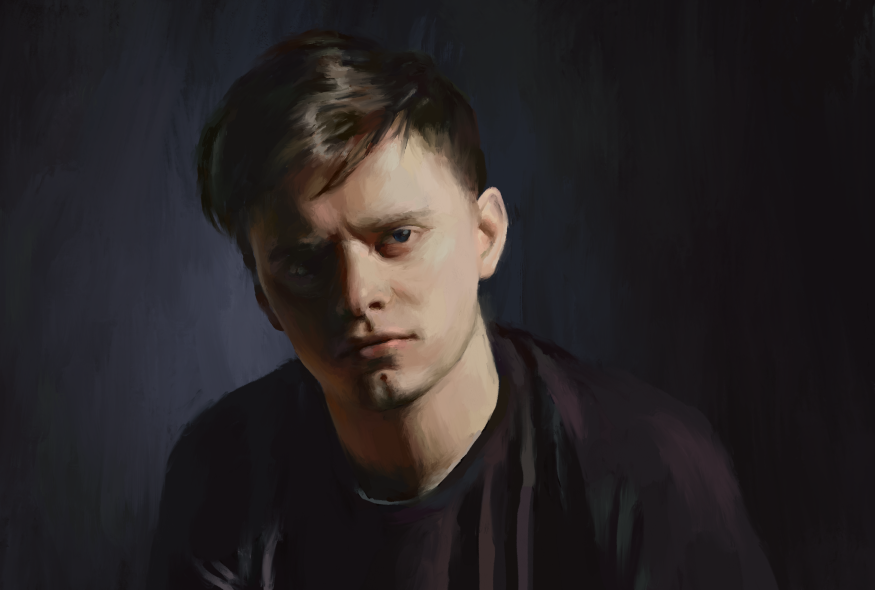
Vyacheslav Zaitsev: Call sign Khortytsia


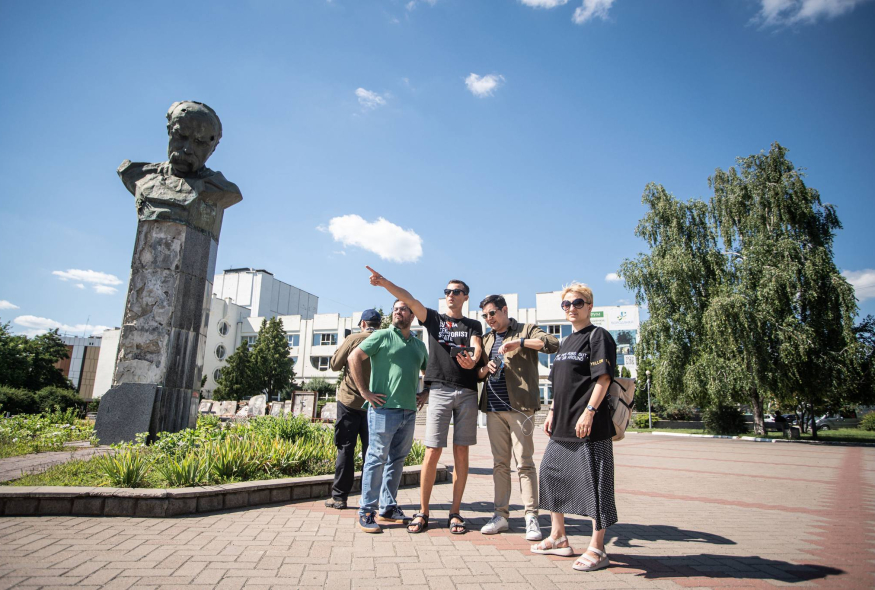
Khortytsia is a twelve-kilometre-long island in the heart of Zaporizhzhia, lying behind the DniproHES dam built on the site of the legendary Dnipro rapids. Khortytsia is home to the Museum of the History of the Zaporizhzhia Cossacks and the Museum of Maritime History, an equestrian theatre and the reconstructed Sich, Eneolithic and Bronze Age sanctuaries, an observatory older than Stonehenge, Scythian mounds and a labyrinth of parklands. Khortytsia is filled with millennial oaks and an intoxicating(strong? sweet?), dry, scorching steppe aroma. When you walk to Khortytsia across the Arch Bridge under the merciless southern summer sun, when you plunge into the shade of a coniferous forest and try to see the silhouettes of deer, wild boars or pheasants among the trees, when you leave the forest on the Taras Shevchenko Trail and stand on the rocks forty metres above the Dnipro, the lines from Kobzar involuntarily caption everything you see:
From end to end, there, it is broad
And joyful like that freedom
Which has long since passed away;
Broad as a sea, the Dnipro,
Steppe and steppe, the rapids roar,
And gravemounds high as mountains.
There was born the Cossack freedom,
There she galloped round, (Tr. by Vera Rich)
Standing on a steep slope with your back to the steppe and your face to the Dnipro, you feel with your burning skin what a "place of power" is. You find yourself in just such a place, and its name is Khortytsia.
"He was Khortytsia in Sloviansk, Ilovaisk, DAP, Bakhmut. Khortytsia was his life and his death. It was for the sake of all of us," Oksana Zaitseva wrote about her husband Vyacheslav, a soldier with the call sign Khortytsia.
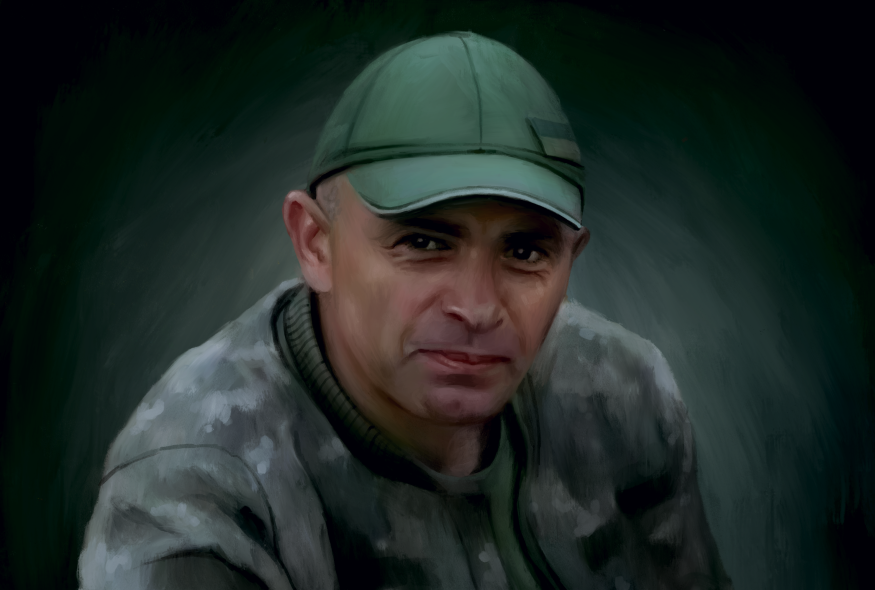
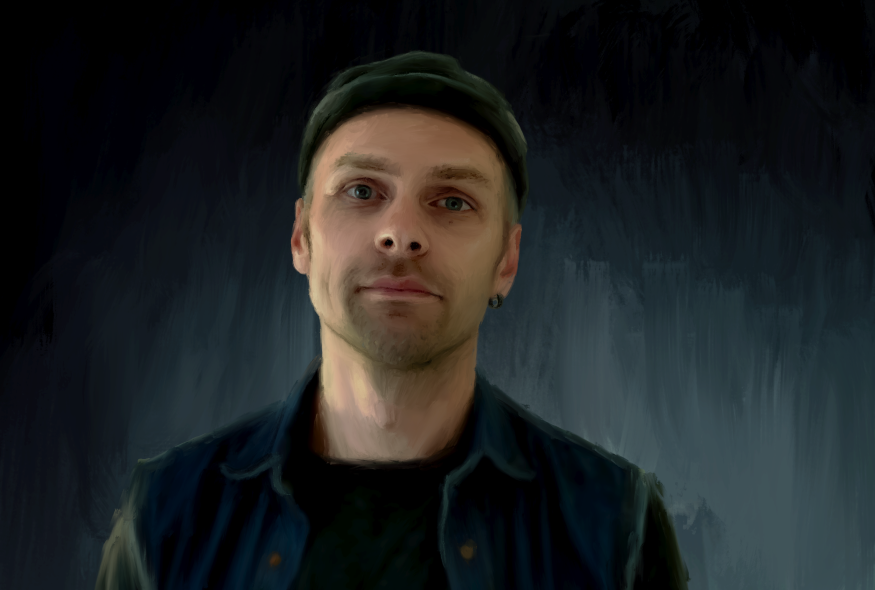
Vyacheslav Zaitsev was a historian, archaeologist, librarian from Zaporizhzhia, head of the Kamianska Sich sector in the Khortytsia Nature Reserve, a member of the Zaporizhzhia City Council, a "cyborg", chairman of the Zaporizhzhia Veterans Council, and a defender of Ukraine. Wounded twice during the first year of the Russian war, he was demobilised in 2015, but returned to the Armed Forces in the lead-up to the full-scale invasion. On 5 October 2022, he was killed in action in the Donetsk sector. The former Mikhail Lermontov Street in Zaporizhzhia was named after Vyacheslav Zaitsev.
**
I first heard of Vyacheslav Zaitsev from my sister Olha Kulihina, who worked as a restorer at the Museum of Zaporizhzhia Cossacks. "Vyacheslav was the most radiant and selfless person in the reserve," Olha said. "He bought us tools, consumables, solvents, and used his 'cyborg' status to find money for our projects." Later, the topic of creative fundraising came up in conversations with all his colleagues: "he found funds for hydroarchaeological expeditions, from diving equipment to the departure itself"; "he helped our employee publish maps of Velykyi Luh before the flood and maps of rapids"; "he organized a collection for expeditions to Kamianske Sich"; "all expeditions in recent years have taken place in those numbers only because of his authority". Vyacheslav also thanked his colleagues for the opportunity to be involved in their work. He himself came to the reserve by public transport and never sought to put his name to a scientific paper, but rather to make academic research possible.
Employees of the reserve recall the latest finds in which Vyacheslav participated - a Cossack and medieval oven, numerous Scythian burials. Together with hydroarchaeologist Dmytro Kobalia, who is also currently serving in the Armed Forces of Ukraine, Vyacheslav explored ancient boats which he called time capsules in the waters of the Dnipro. However, ever since the excavation of the Paleolithic archaeological site Grotte du Lazaret during his student internship in France, it was the Paleolithic that interested him the most. "During the excavations, we always gave him a square where he could sift through sand, earth, clay and find some microlithic particles that no one else noticed," say his colleagues Polina Petrashyna and Anatolii Volkov. "He was a sturdy man, and it was such a dissonance: a giant looking man searching for tiny beads that nobody else could find."
Whenever the vegetation was damaged during excavations, Slava took care to restore it. He would go down the slopes to the Dnipro, fetch water and pour it on the area so that the vegetation could regenerate. Colleagues recall the numerous oak trees he planted in Khortytsia and his concern for nature. "When he was serving in 2014 and his unit was left without supplies, a family of wild boars came to them," Polina recalls his army story, "The guys were ready to shoot them for dinner, but Slava wouldn't let them. They stood in a field of sunflowers and ate the seeds". The giant Khortytsia was guarding life with his weapon in hand.
**
"I always met Vyacheslav either at rallies or on Khortytsia," recalls my classmate Yan Shypula, a professional Cossack from the interactive theatre in Sich before the full-scale invasion, and now a volunteer soldier in the Ukrainian Armed Forces. Zaitsev's revolutionary career began back in 2004, when Yan and I were in the eleventh grade. In the time of the Orange Revolution, Vyacheslav was expelled from Zaporizhzhia National University by court order for throwing mud on a Viktor Yanukovych election billboard. This led to massive acts of disobedience by teachers and students, and Zaitsev was readmitted the same year. "He had always been a patriot. It all started long before the war," says Polina, who was studying with Vyacheslav at the History Department at the time. Even a decade later, Zaitsev still impressed Yan as an ideal citizen: "He showed by his own example how to act when new historical events unfolded in the country."
In the 2018 documentary Sich: Where Resistance to the 'Russian World' Grows From, which told the story of Khortytsia and the Zaporizhzhia resistance in Vyacheslav's voice, he was introduced himself as follows: "I am an ethnic Russian, a historian and a 'cyborg'. I went to the forefront with the first dispatch from Zaporizhzhia in March 2014. I started with Chongar and then went through everything that the 79th Airborne Brigade had to do at the time." During the first year of Russia's invasion of Ukraine, the grenade launcher with the call sign Khortytsia went through Sector D and Izvaryn pocket, two rotations at Donetsk airport and the battle for Debaltseve. In one of his numerous interviews, he told about a conversation with the enemy that he intercepted at the DAP: "They were complaining [to Motorola] that they are fed up with the grenade launcher. It was me. And Motorola said: "Well, kill this grenade launcher already! Kill him already!". I was laughing so hard: here it is, glory has come, the enemy has finally appreciated my merits."
Zaitsev was awarded the Order "For Courage" of the third degree. After his demobilisation, he returned to work in Zaporizhzhia, where he headed the Zaporizhzhia Council of ATO Veterans NGO and became the head of the Scientific Library and Archive Department of the Khortytsia National Reserve. On 23 February 2022, Vyacheslav Zaitsev returned to the Armed Forces of Ukraine.
**
His posts from the frontline in 2022 are a continuous broadcast of enthusiasm and optimism. "They also believe in the Armed Forces," he sneered about Russians fleeing mobilisation. Pictures of the army zoo, videos of the artillery, and occasional assurances that rumours of his death were "a bit exaggerated" were alternated with historical research: in the trenches, Vyacheslav re-read academician Dmytro Yavornytskyi and did not forget to remind his followers of important dates, such as the anniversary of the capture of Moscow by Polish-Lithuanian Commonwealth commander Stanisław Żółkiewski. Burning holes in the screen with his eyes, he quoted lines from his favourite poet Vasyl Symonenko to the camera in the dugout: "My nation is! My nation always will be! No one will efface my nation!"
It seems that a wistful note made its way into his feed only on his daughter's birthday, which coincided with Airborne Troops Day. Contrary to tradition, he has always been sober on his professional holiday, "because on 2 August 2011, my wife and I welcomed our daughter Polina." In 2022, on this day, he wrote: "And my daughter is growing up. My daughter is 11 years old. And dad is at war again." His wife and daughter have always remained at the centre of his crowded world. When asked "What are you fighting for?" Slava answered: "For my family and my land. For my children and the future of Ukraine."
Fighting in the steppes of Donetsk region, he dreamed of an eventual victory and a return to archaeological research in Kamianske Sich, one of the last Cossack capitals on the Dnipro River, a branch of the Khortytskyi Reserve in Kherson region. He did not live to see the liberation of the national park in November 2022, nor did he live to see the Russians blow up the Kakhovka hydroelectric power station in June 2023, which changed this historic landscape forever.
Besides his service, Vyacheslav Zaitsev's life was filled films by Sergio Leone and Christopher Nolan, his favourite Metallica music and Tarantino soundtracks, skydiving and scuba diving. His life was complete with daughter Polina, blue-eyed like her father, and wife Oksana, his Penelope. The fire that he always kept alive during expeditions, falling asleep next to it under the stars. The fire that he knew how to ignite in people around him. In memory of Vyacheslav Zaitsev, it is up to us to keep this fire burning.
Vyacheslav Zaitsev was born on 6 September 1980 in the village of Ivanivka near the city of Enerhodar, Zaporizhzhia region. In 1998-2000, he served in a combat airborne unit in Bolhrad. In 2003-2008, he studied at the History Department of Zaporizhzhia National University. In 2010, on Taras Shevchenko's birthday, he met his future wife Oksana, and in 2011, their daughter Polina was born. Until 2014, he worked as a guide at the Khortytsia National Reserve. In 2014, he voluntarily went to the front and fought in the 79th separate airmobile brigade. He went through the Southern Pocket, the defence of Donetsk airport, and the battle for Debaltseve. He was wounded twice. He was awarded the Order "For Courage" of the III degree. After returning from the front, he headed the Zaporizhzhia Council of ATO Veterans and became the head of the Scientific Library and Archive Department of the Khortytsia National Reserve. In 2015, he became a deputy of the Zaporizhzhia City Council and chaired the City Council's Standing Committee on Education, Science, Culture, Sports, Youth and Tourism. On 23 February 2022, he returned to service in the Armed Forces of Ukraine. On 5 October 2022, Vyacheslav was killed in a battle in the Donetsk region. On 12 October 2022, the former Mikhail Lermontov Street in Zaporizhzhia was named after him. He was posthumously awarded the Order "For Courage" of II degree.
Read also:
We need your help to create projects and materials aimed to defend freedom of speech, popularize Ukrainian culture and values of independent journalism.
Your donation means support for discussions, awards, festivals, authors’ trips to regions and PEN book publications.