Ukrainian writer Kateryna Yehorushkina: "To give light in the darkest moments"

The interview with Kateryna Yehorushkina was conducted by Rasa Milerite, the editor of the book The Holiday I Had to Take.
In her foreword to Lithuanian readers, Kateryna Yehorushkina writes: "I believe that memory can protect. I believe that this honest book, full of light, will help to guard Lithuanian children from war." Kateryna's book The Holiday I Had to Take has already been translated into several foreign languages, and now it is being published in Lithuania (translated from Ukrainian by Donata Rinkevičienė, illustrated by Sofia Avdieieva, published by Slinktys).
"The genocide happened again, my little readers died of hunger, cold, shelling and dehydration. Mothers and sisters were raped and killed before their eyes. Children`s hair turned grey, and thousands of them were taken to orphanages in Russia. Many of my little readers turned to ashes," says Kateryna Yehorushkina.
The book's plot is based on the format of a diary, telling the story of the first days of the war and the wounds that war leaves on children. Yehorushkina admits that she was inspired to create the story about the forced vacation because she wanted to give light to young readers in their darkest and most painful moments, and because she thought that this book would help the world understand Ukrainians. Some episodes of the diary were written amid the sound of night air raid sirens.
K. Yehorushkina (born in 1984) is a Ukrainian writer, poet, art therapist and author of innovative projects for companies. In March 2014, she became one of the signatories of the Statement of Ukrainian Cultural Figures to the World Creative Community regarding Russian aggression. The writer has created 18 books for children and adults; her books are also published abroad: in Lithuania, Bulgaria, Georgia and other countries, and excerpts are included in Ukrainian textbooks and studied in schools. On 24-25 February, the writer visited Lithuania and met with readers at the Vilnius Book Fair, the Utena Public Library, and the capital's gymnasiums.
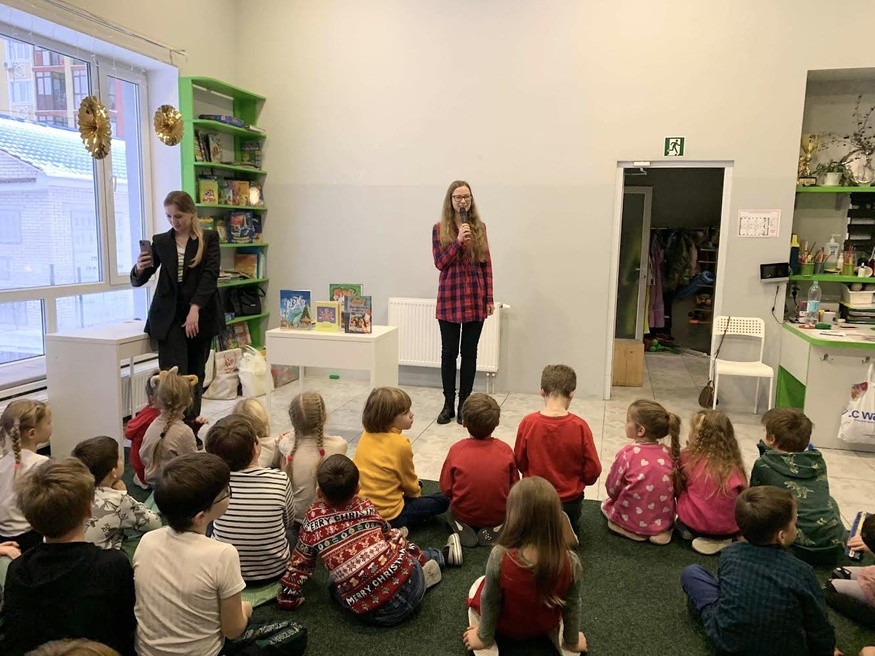
- Dear Kateryna, I would like to start this conversation not with literature, but with a simple human question — how are you today? Are you safe?
Now my family and I are in Western Ukraine. It's safer here than in my native Kyiv region, but recently rockets have been flying here too. In Ukraine, all of us are targets for Russian weapons simply because we are Ukrainians, who, according to Russia, should not exist. Similarly, many other people who for some reason do not want to consider themselves Russians or "little brothers" should not exist.
- The Russian attack, which began on 24 February 2022, has divided the whole life of Ukraine into two parts. What was your daily life both as an artist and as a family member like before the war started and what is it like today?
At the beginning of February, my friend and I went to Cyprus to spend some time in the sun and relax. We rented a room there and I was working on the second book in the series about Horishkovi Plavni (the first was published in Lithuania in 2021). There, I had a dream that my husband was taking my daughter to school in a large plastic tank, and our usual road was covered with shell holes (by the way, I used this dream in the book The Holiday I Had to Take). The dream was so realistic that I called my husband and asked him to take the children to Western Ukraine, to his parents. This decision saved our children from unnecessary stress, as their friends spent several weeks in basements until they could evacuate.
On 21 February, our plane landed at almost empty Boryspil airport. It was probably one of the last passenger planes to land in Ukraine. I had plans to finish the manuscript of the book I was working on in Cyprus, speak at a conference and go to my children. But on the 24th, I woke up to the sounds of explosions. I went out to the balcony to tape the windows to protect myself from the blast wave. I saw Russian helicopters near my house. After that, I packed my suitcase and set off on foot to Kyiv (the taxi refused to go). I walked about three kilometres and then kind people gave me a ride to the metro. It was an absolute miracle that I was able to leave Kyiv for Western Ukraine that day.
Until 24 February, we had a wonderful life. My daughter went to a good private school, my son to a kindergarten in a neighbouring building. We were finishing repairs in our dream apartment in a new building. We paid off the last part of the mortgage in March, when the Russians were already near my town and shelling its neighbourhood. When we fled the war, we first lived with relatives, and now we rent an old apartment because renting a good one in this region is difficult. We found a school and a kindergarten. When missile attacks start, we go to the shelter. When the power goes out, we light candles and put on warm clothes to keep warm. Of course, the children miss their friends and our previous life. My three-year-old son occasionally packs his toys in his suitcase and insists that it's time to go home. I tell him that there is more war at home than here. Then he slowly takes the toys out of the suitcase and puts them in a cardboard box. My daughter knows that people were killed by a Russian missile in our hometown, and children were seriously injured. So even though she misses home, she understands why we are here.
- On social media, I see how united, brave, supportive and ready to fight Ukrainian artists are. Can you tell us more about the mood of the Ukrainian artistic community today?
Many artists have become volunteers, raising funds for military vehicles, drones, and Bayraktar UAVs. Some joined the Armed Forces. Some are actively communicating the truth about the war in the Western media, travelling with performances, and engaging in cultural diplomacy. The community is really quite united and it is good to know that we are supported by colleagues from abroad. For example, I had the opportunity to work at an artistic residency in Poland last summer. It was there that I finished my manuscript, to which I could not return after 24 February. It is important for us, artists, to be heard, so I am happy when the books of Ukrainian authors are translated, when there are lively reviews, when the world discovers Ukraine. Unfortunately, many creative projects have been frozen because of the war. Several publishing houses have closed down, and printing houses in Kharkiv are working under constant shelling (by the way, it was there that the Ukrainian edition of The Holiday I Had to Take was printed). But the worst thing is that many artists have been killed by the invaders. For example, children's writer Volodymyr Vakulenko. He was abducted from his home in the Kharkiv region, tortured and killed. Simply because he loved Ukraine. Volodymyr left behind a son with autistic spectrum disorder. The writer raised him alone. The publishing house has now republished Volodymyr's book Daddy's Poems to support the child financially.
- In the first days of the war, you wrote a children's book called The Holiday I Had to Take, in which you tell us how a child sees the war. What inspired this book and under what circumstances did you write it?
When I more or less got over the first shock and accepted the new reality, I started thinking about how I could help our Victory. I called the volunteer centre, but there were plenty of student volunteers there. At the same time, my eight-year-old daughter Daryna started asking me about the war and its causes. She needed to talk about this experience and, at the same time, she was looking for support and hope. This book really was born out of our conversations and my thoughts during the nightly air raids. I had already had experience writing books for children on difficult topics: The Holodomor (the genocide of Ukrainians in 1932-33), the Second World War, preserving national identity in exile... So I hoped that I would be able to address this topic in depth, honestly and at the same time with care for the readers, to fill the darkest and most painful moments with light. We know very well that unspoken traumatic experiences have a stronger impact on us than spoken ones. But we need to work with them carefully.
I wrote the manuscript itself in a week, in early March, during my daughter's forced vacation. I locked myself in a room in my relatives' attic, with Ukrainian military aircraft periodically roaring overhead. I had no time to procrastinate, because I knew that at any moment a missile could reach here, and then I would be late. I was also inspired by the idea that this book would help us understand the world, foster empathy and build warm and sincere connections between people from different countries.
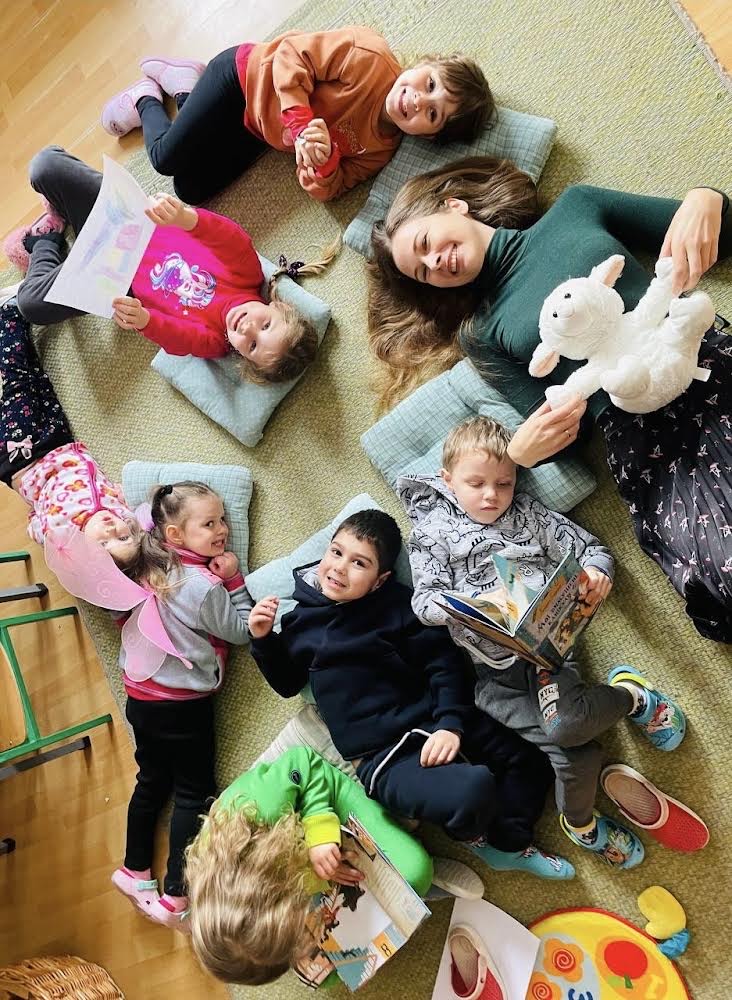
- You have chosen a contradictory title for your book: a vacation, but a forced one. There are many contrasting images in the book: a sandbox with an artillery shell in it; a mother who wanted to lose weight and probably will, but because of the constant running for cover; paper snowflakes on the windows and duct tape crosses stuck on them for protection; a wedding photographer who is filming the war... Why did you choose the motif of contrast, what does it help to emphasise?
I did it unconsciously. Our whole life is now defined by contrasts. Everything is divided into "before" and "after". Instead of traditional spring vacation, the children had forced vacation at the end of February. It was not a vacation to relax, but to escape the war. Under stress, many of them drove for the first time to leave. Some learned to cook for the first time to feed refugees. And some lost their loved ones for the first time. When I was collecting stories from children and adults in the de-occupied territories and interviewing witnesses, one girl from the Kyiv region told me how she lost her godfather. She said that the Russians were playing "russian roulette" on their road. They let one convoy of cars with refugees through, and shot the other. That's how her godfather and his son died. The family was only able to bury them a month later because they were under occupation.
- When we think of war, we first of all think of fear, panic, and the desire to escape. The heroine of your book, Vira, is a brave and thoughtful girl. She helps her mother look after her brother, misses her peaceful life, and intends to learn history and English as best she can to tell the world about the devastation of Ukraine by the Russian invaders. Why is it important for you to portray such a child in this book?
I communicate with children a lot, so I understand how different they can be: in terms of temperament, experience, hobbies, and worldviews. In addition, our children began to grow up quickly because of the war, so I wanted to show this moment in Vira's story. Her invisible backpack includes fears, anxieties, new responsibilities, and early adulthood. When the family finds themselves in Lviv, the girl takes off this invisible backpack and tries to return to her childhood: school, friends, a coffee shop, a playground. On the one hand, Vira now appreciates life more than ever, but on the other hand, this knowledge has come at a high price. Very often, children become deeply thoughtful as a result of trauma or serious trials, because they had to comprehend and live through the traumatic experience and integrate it into their lives.
- You are actively presenting your book in Ukraine, even in difficult conditions. How do Ukrainian children perceive this?
Yes, sometimes my book presentations in Ukraine are interrupted by missile attacks and air raids, so we run to the basement. Whenever possible, I try to find a shelter beforehand. Like it was with the Lviv Puppet Theatre. There, the presentation of The Holiday I Had to Take took place on the lower stage, and when the air raid started, I calmly signed autographs and hugged children.
I prepare for every presentation, because now there are children from the war zone everywhere. I try to find out through adults how traumatised these children are in order to build the right balance of truth and psychological support. The first presentation of this book was online, for children in the Donetsk region who live near the front line. The teacher said that some of these children's homes were destroyed by the invaders, and their villages were wiped out. Honestly, after this presentation, I cried because I realised that my book was powerless to bring back the home and the world they loved. I had an attack of self-depreciation: when you see that the Russians are destroying the worlds of Ukrainians much faster than we are able to rebuild. But the teacher's feedback gave me hope: she said that I had comforted and supported the children and taught them how to cope with stress. This means that they will have the strength to study and have the strength to grow up even in times of war.
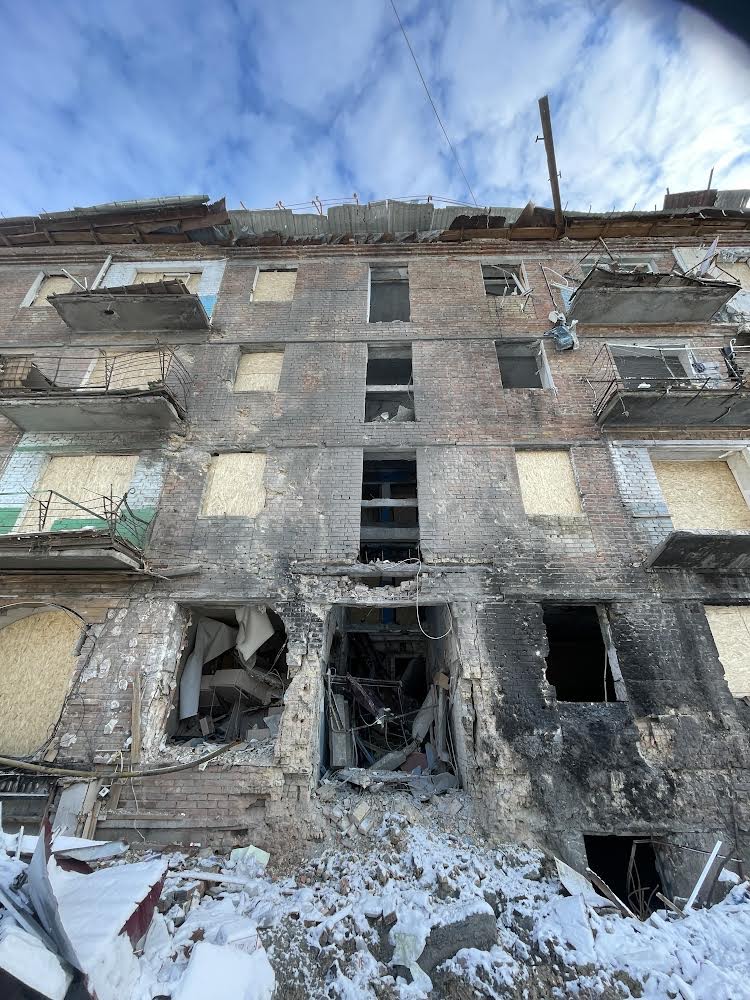
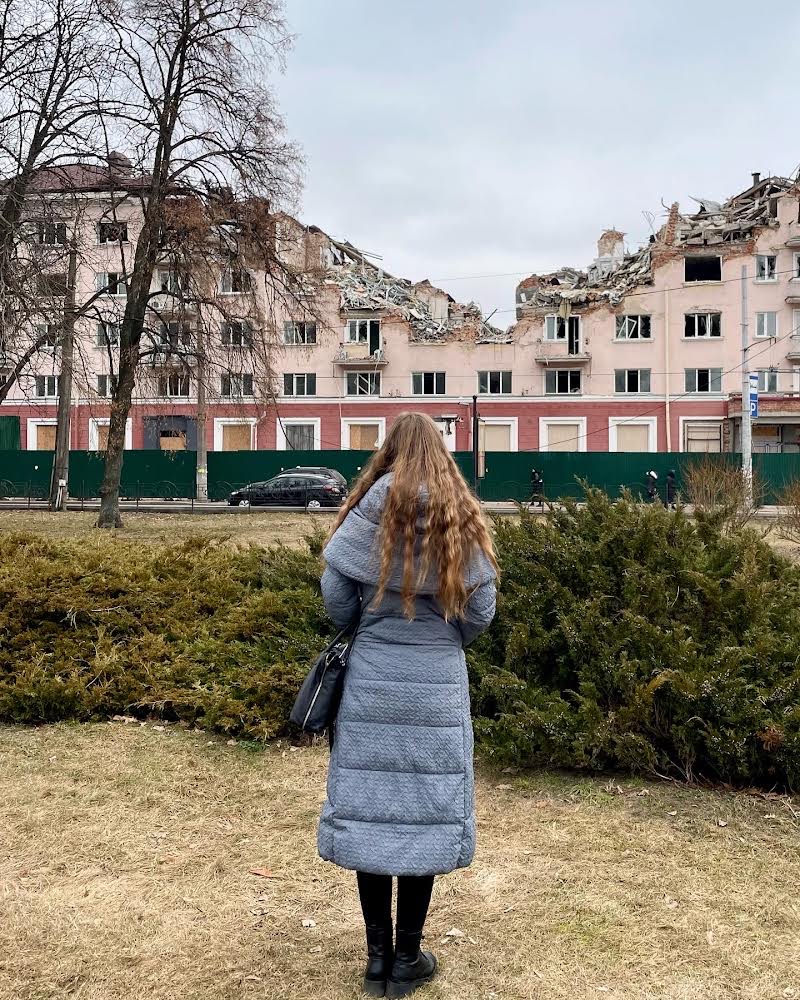
More recently, there was a presentation in Chernihiv. The city has been under siege for a long time, and the invaders have committed terrible crimes on its outskirts. There is a lot of destruction, including of libraries. When we were leaving, twenty Russian missiles were flying over our region. I thought at the time that I was too used to war and had lost my caution. But I see the sense in my work. The readers were grateful for the in-depth conversation and support. Together with PEN Ukraine, we brought a lot of books to donate to libraries and restore their collections.
Another presentation took place in liberated Irpin. When I was entering the city, I saw the demolition of high-rise buildings damaged by the Russians. It was a terrible sight. The school principal told me how they had rebuilt the school and repaired a shell hole in the stadium. Together with the children, we sang "Chervona Kalyna": this is the song Vera was learning on 23 February (if you look closely at the illustration, you can see the notes on the piano). After the presentation, the blackout started: the whole city lost power. I was walking back through the dark streets, and around me were beautiful half-destroyed modern buildings with panoramic windows. They still had advertising banners on them: buy a home in our elite apartment building.
- It's not easy to write for children about such a complex topic, to talk to them in a way that they can understand, isn't it? How do you find the right words, what methods do you use?
I am a very empathetic person, always attentive to the audience. That's why I choose my words carefully, and I use art therapy and psychological practices that are described in the last chapter of the book (by Svitlana Roiz). At the end of the presentation, I invite the children to draw magical creatures that will protect their towns, villages, and loved ones. Recently, at a presentation in Kyiv, children drew cat-angels, houses with wings (which are safe during shelling) ... And one boy invented and drew an Orc Roaster. He said that it was a fire-breathing snake that would roast orcs (the invaders) as soon as they approached his city. I believe that such aggression is healthy because it is aimed at defence. And it's good that children have the opportunity to express it through drawing. We have sent all the works of these children to the wounded soldiers in the hospital.
- In Lithuania, we are increasingly hearing from certain audiences that art should not be confused with politics. This means, on the one hand, that art is not able to educate a civically strong, politically responsible society, and on the other hand, that we should leave fiction and fictional stories to art. What do you think about this statement?
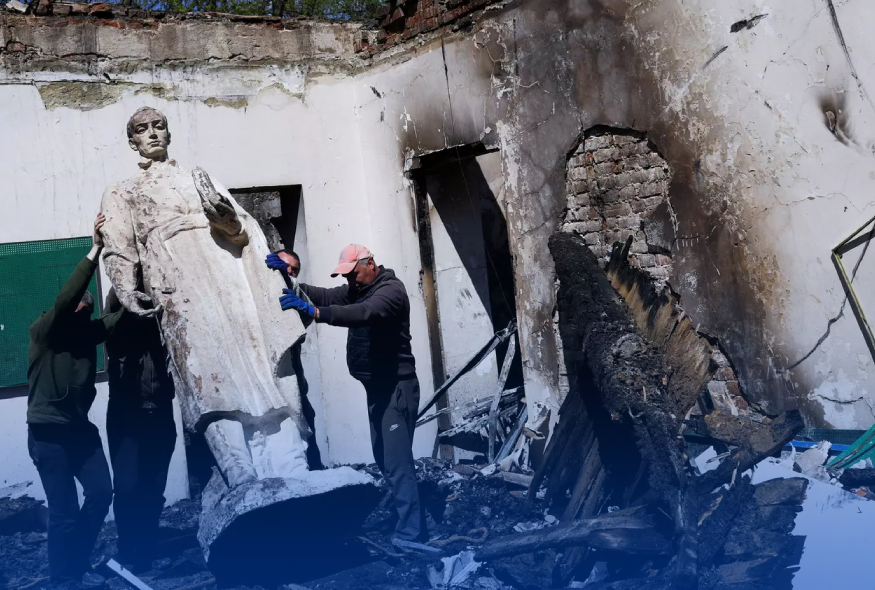
In my opinion, art is based on certain values and worldview. And if art does not transmit the values of human life and respect for one's neighbour, if it promotes the superiority of one nation over others, it ceases to be art and becomes a tool of propaganda. The Russian invaders have destroyed many Ukrainian cultural sites and monuments. They killed many of our artists: painters, writers, singers, ballet dancers and even the little gymnasts and actresses, girls, who had won international awards and could have become our cultural elite. Some of them were hanged, some were shot, some died in the basement of the Mariupol Drama Theatre. The Russians poured concrete over the bones of Ukrainian artists and held a concert with Russian pop singers. Ukrainian books in the occupied territories were targeted for burning, and a list of "dangerous literature" was compiled, which included books by many of my colleagues.
In September 2021, I presented my book about the Holodomor in Mariupol. It was in a wonderful modern library. Now it is gone. The genocide has happened again, and my little readers died of hunger, cold, shelling, and dehydration. Their mothers and sisters were raped and murdered before their eyes. Children turned grey, and thousands of them were taken to orphanages in Russia. Many of my young readers turned to ashes (the Russians actively used mobile crematoria to hide their horrific crimes).
I could talk for a long time about why Russian artists are responsible for Russian aggression (even if they are silently watching). But I am afraid to hurt Lithuanian readers too much. Therefore, as long as the Russians are killing our future and our culture, their cynical culture should have no place in the civilised world.
- Can art in the hands of an aggressor become a powerful tool for spreading propaganda?
Yes, it can. This has always been the case. Moreover, the Russians have been preparing for this war for a long time, spreading their propaganda narratives about "one nation", "big brother", and "inferiority" of other nations, including through literature. They were writing fiction about Crimea as part of Russia long before the occupation, preparing the ground. They spread their propaganda messages even at the level of esoteric literature, where a "guru" said that "a new great Vladimir" would come, who would unite the "brotherly peoples" into one nation and save them from the destructive influence of the West. I remember how, even before 2014, Russian writers came to our book exhibitions and spoke arrogantly about our literature. For a cultured person, listening to Zakhar Prilepin in Kyiv was simply disgusting.
-The Holiday I Had to Take is your second book published in Lithuania. You are a respected writer in Ukraine, your books are published all over the world, but in Lithuania, very few people know about you. Please tell us what brought you to children's literature.
I wrote my first poem at the age of seven and then decided to become a writer. I came to children's literature closer to the age of 19, when my first adult book was published. One of the reasons is that I understand children well, and I keep in touch with my inner child. Through my stories, I wanted to be an empathetic friend for readers, with whom they could talk about any topic. Judging by the reviews and translations of my books, I'm doing a pretty good job. Of course, this inspires me to keep working.
- You started your career writing poetry. Is this genre important in your creative life today?
Yes, indeed. My first collection of poetry, The Pulse of a Moment, was published on a grant from the President of Ukraine in 2005. Since then, I have written a new collection of poems — Derevorytmy (this is my neologism, where the wordplay is: rhythms + trees). Among the new poems, there are many about the war. They were translated into English and shared on social media. Unfortunately, it is very difficult to publish poetry in Ukraine because of the crisis. Authors are often forced to resort to self-publishing or to be published with the help of sponsors.
Poetry is very important to me. It is through poetry that I am able to express the most subtle, complex, painful things. Sometimes I can write one poem in several stages because my eyes are covered with tears. By the way, many readers have said that my poems made them cry for the first time since 24 February. I think it's very important to release emotions and feelings: so that we don't become numb and stiff in our trauma, but remain alive, sensitive, even if it hurts. In this way, poetry becomes therapy.
- Have you ever tried to write (or have you ever written) a novel?
When I was eleven years old, I started writing a love story, but I left it on the train. Now I have an idea for a novel in short stories about identity. Perhaps I will complete it after working on my next children's book. I am also working on a book for adults called Voices of Witnesses. These are my diary entries about the feeling of war, the role of writers, and transformations... combined with testimonies of people who survived the Russian occupation.
- Is there place for self-expression when writing for children? How important is self-expression in literature for you?
Yes, of course. There is self-expression, but it is never complete. That's why I keep writing: not only for children, and not only prose. Besides, writing for children is very responsible. Especially on complex topics. You can never be sure whether a child will have reliable adults around to support him or her in experiencing difficult emotions. So when I write for children, I combine my childlike sincerity and rich imagination with adult care. This is really important.
- What are the most important principles you follow when writing for children? As far as I know from Donata (the translator), you don't write on one-day topics. For example, you wrote a book about sorting rubbish. Now you have a book about the war. How important is it for you that your works for children deal with topical issues and have an educational value?
If I write books only upon commission, I will be hurt by my own unfulfilled ideas. If I have something to say to this world and my heart is on fire, then I shouldn't switch to other people's topics. Otherwise, I start to get sick and lose touch with my own voice. And in this way, both I and the readers lose something unique. As for the educational value: it is never intrusive in my books. Between the lines, I share my worlds, values, and experiences, and the reader chooses whether it resonates with him or her and becomes a part of his or her worldview.
- What is contemporary Ukrainian children's literature: what topics and genres prevail? In Lithuania, we lack good poetry for children by contemporary writers. Perhaps this genre is popular in Ukraine?
Now we are publishing books for children on the theme of war: realistic stories, fairy tales, and novels for teenagers. Fantasy is also gaining popularity, as children want to escape from reality. They also read comics. Unfortunately, there is very little poetry for children now, although rhythmic texts are therapeutic by themselves. Publishers are now saving money on poetry. So, for example, my poetry book for children, The Alphabet from Which the Goat Has Escaped, was delayed. Even most of the illustrations are already there, but now there is no one to publish it.
- Kateryna, what do you miss most when you reflect on your pre-war life?
Walking in our native pine forest near my home. Now you have to walk carefully there. Our home movie projector and watching films and cartoons in each other's hugs. Our relatives. Friends who have moved to different countries and even different continents. The smells of my home. My flowers in flowerpots: unfortunately, some of them died because of the war. My library. I also miss being able to plan in peace. Now the uncertainty is so dense around me that I have to be incredibly optimistic not to be disappointed and still make plans for the future. Before the full-scale invasion, my husband and I were planning to buy a bunk bed for our children's room, but now I think it's better to let them sleep next to us, because if a missile comes, we will either escape or die together and avoid unnecessary suffering.
- The whole world is open to you. It would be quite understandable if you decided to leave for a safe country. What made you decide to stay in your home country?
Indeed, I had opportunities to go abroad, live there and even receive a scholarship as a writer. But my heart is here, my people are here. Staying in my homeland and developing Ukrainian culture, raising my children in a Ukrainian-speaking environment is also my defiance against the invaders. This is the affirmation and preservation of my national identity, the answer to the question "Who am I and who will my children be?".
As for emigration. Unfortunately, the experience of a person who has been through war and one who has not is very different. It is difficult to convey the experience of war in words, because the listener or reader's mental defence mechanism is triggered. Sometimes it takes the form of victim-blaming: they look for reasons for the aggressor's actions in the victim's behaviour. In this way, people try to protect themselves from the idea that war can come to anyone: a talented ballerina, a stylish barista, a newborn baby or a children's writer. Every Georgian, Pole, Lithuanian, Finn or Moldovan. To every neighbor of a terrorist state.
It takes a lot of wisdom, empathy, and a desire to understand so that these experiences do not create a gap between Ukrainians who are forced to leave and representatives of host countries. Personally, it is easier for me to live under the threat of missile attacks than under the threat of misunderstanding. Besides, I don't want to be in the countries where Russians are now living en masse. After they killed hundreds of thousands of innocent Ukrainians, it is too painful for me.
 Source - www.menobangos.lt
Read also:
We need your help to create projects and materials aimed to defend freedom of speech, popularize Ukrainian culture and values of independent journalism.
Your donation means support for discussions, awards, festivals, authors’ trips to regions and PEN book publications.